Assistant of the President of the
Republic, Musa Mohamed Ahmed, Monday received in his office at the
Republican Palace the Dean of Fine Arts and Design Faculty at
Al-Mustaqbal University, Prof, Hussein Jama'an Omer, and discussed the
possibility of establishment of a museum for Sudan heritage in general
and for heritage of East Sudan especially.
Prof, Jama'an said in a press statement after the meeting that he
acquainted the Assistant of the President of the Republic on richness of
the Sudanese heritages and reached agreement with him to conduct a
comprehensive study for building a museum in Khartoum to include works
on the Sudanese folklore and East Sudan artistic works.
He affirmed that he felt understanding and support of the Assistant
of the President to the idea, explaining that efforts are underway to
find a site in Khartoum for building the museum.
http://allafrica.com/stories/201309170344.html
June 4, 2014
Freedom of religion in Sudan - a dilemma
On 15 May, a Khartoum court sentenced 27-year old Mariam Yahia Ibrahim Ishag to death for apostasy for the supposed crime of converting to Christianity. The sentence was handed down after Ms. Ishag — who was pregnant at the time and has since given birth in prison – refused to recant her faith.
Sadly, her case represents a pattern of violations of fundamental religious freedoms in Sudan, which instituted the death penalty for apostasy in 1991. This is the case in only three other African countries: Nigeria (in some northern states), Mauritania and Somalia.
Such religious intolerance in Sudan is an oxymoron, as the country, even with the loss of South Sudan, still remains one of the most diverse countries in Africa.
Sudan is home to sizable minorities with distinct cultural heritages and languages; as well as religious minorities, including Christians of various denominations, and followers of traditional African religions.
But since 1989, following the Islamist–sponsored military coup led by President Omar al-Bashir, the Government has treated Islam as the official state religion, instilling in the country’s laws, institutions and policies.
Since, thousands of non-Muslims have experienced discrimination at the hands of the state. Human rights groups have documented numerous cases of state-sponsored discrimination, including the destruction or confiscation of churches. Thousands of non-Muslims have also been forced to convert to Islam, priests and church leaders have been persecuted, and thousands of Christians punished according to Sharia law.
Yet, Christianity boasts a long and rich history in northern Africa, including northern Sudan, dating back to the first century.
Read the entire opinion piece.
Many followup stories are identified here.
May 30, 2014
New road between Egypt and Sudan to open
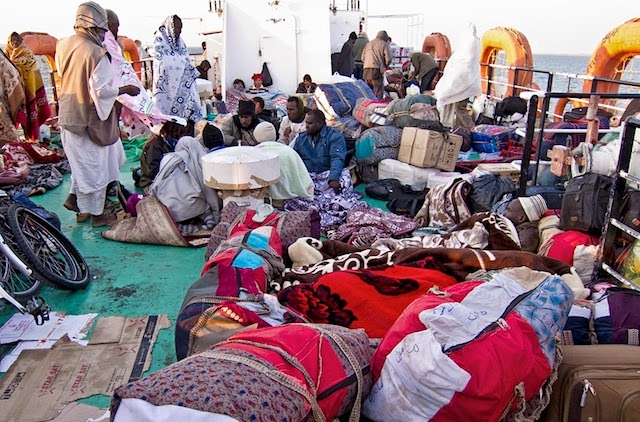
And who will ride the ferries across Lake Nassar? And will they be missed?
One motorcyle traveller says he would be Waiting 7-8 hours and sailing on the ferry from Aswan to for another 17-18 hours. Driving would have taken max. 5 hours.
Khartoum — The Egyptian minister of Commerce, Industry and investments Munir Fakhri Abdel-Nur announced the land crossings between with Sudan will be opened over the next few days to facilitate the flow of trade between the two countries as well as central Africa and Common Market for Eastern and Southern Africa (COMESA).
Egyptian minister of Trade, Investment and Industry Munir Fakhri Abdel-Nur
According to Egyptian news agency (MENA), Abdel-Nur made the revelation at the opening ceremony of the workshop organized by the trade agreement sector at his ministry and the United Nations Development Programme (UNDP) on trade facilitation through the development of ports and border crossings management.
The minister underscored the importance of strengthening the performance of trade and transport corridors between Arab countries to increase the flow of goods and people across borders and to help achieve regional economic integration.
He also stressed the need to eliminate current obstacles and challenges that hampers the development of inter-Arab trade which Abdel-Nur Said accounts for only 10% of the total regional trade.
Observers say that the inauguration of border crossings is held up by disagreements over the Halayeb region which both countries claim.
allafrica
May 28, 2014
Suakin port - workers strike
Last Saturday (May 26) workers and employees of the Containers Transportation Department of the Southern Port in Port Sudan entered an open-end strike protesting their low salaries, temporary contracts and the payment of delayed allowances. The strike immediately led to an accumulation of containers on the pavements of the Southern Port.
http://allafrica.com/stories/201405262034.html
October 6, 2013
Eritrean kids trafficked for body parts
The
Free Lions, a former anti-government movement in Kassala State said
that entities involved in human trafficking in eastern Sudan are
violating human rights. Human trafficking and trade in human organs are
some of the key human rights violations, the Free Lions said.
Various
media have reported that human trafficking is occurring in eastern
Sudan along areas bordering Eritrea. Ethiopian and Eritrean refugees as
well as Sudanese are being targeted by the traffickers.
El-Fatih Mahmoud Awad, a communication officer for the Free Lions Movement spoke to Sudan Radio Service about the issue.
“In
fact the issue of human trafficking has become famous. The dangerous
thing is that they smuggle small children between the ages of 11-14 from
both genders with the aim of getting human organs,” he added.
He claimed that the criminal groups behind the practice have devices for preserving organs harvested from the victims.
“They
are taking the adults to the desert. They have fridges and doctors to
harvest organs like kidneys, eye corneas and blood. This has become a
booming trade,” he added. Awad appealed to the government to address the issue seriously.
Last
week, the United Nations High Commissioner for Refugees (UNHCR)
expressed its concern about kidnappings and smuggling of Eritreans in
eastern Sudan.
Source. SudanRadio.org
October 5, 2013
Work permits for 30,000 Eritrean refugees
Nearly 30,000 work permits will be granted to refugees in Sudan's Kassala state under an agreement with the UN refugee agency to improve the livelihoods of refugees and reduce their dependence on external assistance.
Thousands of Eritrean refugees live in large camps near Kassala city.
The agreement between UNHCR and Sudan's Commission for Refugees (COR), Kassala State, and Kassala Ministry of Finance - last week after negotiations that began in late 2011 - is an unprecedented step for refugees in Sudan. Work permits are essential for refugees to legally work and have the same employee rights as Sudanese citizens.
September 18, 2013
September 16, 2013
Iron Factory to open in Red Sea State
The Minister of Minerals, Kamal Abdul-Latif, announced that the
inauguration of the Chinese Iron concentration Factory in the Red Sea
State would be next Wednesday {September 18, 2013}. In a statement to SUNA, Abdul-Latif said
that the factory is considered part of the Chinese Companies'
contribution to development of the minerals sector in Sudan.
He noted that the factory operates in concentrating iron and raising its quality for preparing for international competition, affirming his ministry endeavor to develop the production of all minerals in Sudan, top of them are chrome and copper.
http://allafrica.com/stories/201309160864.html
Questions that readily arise include: Will local people get any jobs? Where exactly is this located? What return comes to Sudan? - presumably China gets the pig iron?
He noted that the factory operates in concentrating iron and raising its quality for preparing for international competition, affirming his ministry endeavor to develop the production of all minerals in Sudan, top of them are chrome and copper.
http://allafrica.com/stories/201309160864.html
Questions that readily arise include: Will local people get any jobs? Where exactly is this located? What return comes to Sudan? - presumably China gets the pig iron?
August 25, 2013
2006 Peace Agreement not fulfilled yet
Over 700 Beja militants who voluntarily demobilized after the peace agreement was signed some years ago, with the expectation that they would be given jobs in the Sudanese Army, or in a police force, have been on sit-in strike for almost a month, as they still wait for placements.
From a report on RadioDabanga:
A sit-in strike by 769 demobilised Beja Congress fighters at the Office of Reintegration and Demobilisation in Port Sudan, capital of Red Sea state, has entered its 24th day, apparently without any resolution in sight.
The ex-combatants complain that the government has not absorbed them into the civil and military services as stipulated in the Eastern Sudan Peace Agreement (ESPA) signed in 2005.
Hamid Idris, a member of the Legislative Council of Red Sea state, told Radio Dabanga that the demobilised
Beja Congress fighters are maintaining their sit-in for the 24th consecutive day without the national or state governments responding to any of their demands.
Idris cautioned that disregarding the demands of demobilised combatants could lead to an escalation of the situation.
The provisions of the ESPA on security arrangements called for the return of Beja Congress combatants from Eritrea, where they were based, and their integration into the Sudan Armed Forces under Disarmament, Demobilisation and Reintegration (DDR) supervision.
etc
From a report on RadioDabanga:
A sit-in strike by 769 demobilised Beja Congress fighters at the Office of Reintegration and Demobilisation in Port Sudan, capital of Red Sea state, has entered its 24th day, apparently without any resolution in sight.
The ex-combatants complain that the government has not absorbed them into the civil and military services as stipulated in the Eastern Sudan Peace Agreement (ESPA) signed in 2005.
Hamid Idris, a member of the Legislative Council of Red Sea state, told Radio Dabanga that the demobilised
Beja Congress fighters are maintaining their sit-in for the 24th consecutive day without the national or state governments responding to any of their demands.
Idris cautioned that disregarding the demands of demobilised combatants could lead to an escalation of the situation.
The provisions of the ESPA on security arrangements called for the return of Beja Congress combatants from Eritrea, where they were based, and their integration into the Sudan Armed Forces under Disarmament, Demobilisation and Reintegration (DDR) supervision.
etc
July 24, 2013
Hunger in East Sudan? Let's fix it, please.
Sudan warns of looming famine in eastern region, asks UN help
Text of report in English by independent, Nairobi-based Sudan Radio Service, funded by US State Department on 22 July
A leaked letter purportedly from Sudan's ministry of interior warns of a looming hunger crisis in Eastern Sudan due to lack of rain and... deteriorating environmental conditions.
The alleged letter, written by Interior Minister Ibrahim Hamid Mahmud, is addressed to Ali Hasan Zatari, the UN resident coordinator for humanitarian affairs.
Dated 19 July, 2013, it quotes figures from national health institutions saying that scarcity of rains, deteriorating environmental conditions and conflicts, have contributed to high rates of malnutrition among the general population in eastern Sudan.
The letter adds that these factors have negatively impacted the livelihood of the people in eastern Sudan, and may lead to a disaster.
The letter then urges Zatari's office to fund efforts to cover for the existing food gap. It adds that the implementation of the effort to alleviate the food shortage will be undertaken by the Sudanese Red Crescent Society and government partners in the eastern Sudan states.
"Because of this we write to you hoping for your generous and appropriate contributions in filling the gap, while the implementations will fall on the shoulders of the Sudanese Red Crescent Society (SRCS) and government partners in the States."
Sudan Radio Service's attempts to contact Zatari for comments on this issue were unfruitful. Efforts to reach [the] commissioner for relief affairs coordination, Sulayman Abd-al-Rahman, were also unfruitful.
[Sudan Interior Minister Ibrahim Hamid Mahmud is from east Sudan and member of the Bani-Aamr ethnic group]
Source: Sudan Radio Service website, Nairobi, in English 22 Jul 13
Text of report in English by independent, Nairobi-based Sudan Radio Service, funded by US State Department on 22 July
A leaked letter purportedly from Sudan's ministry of interior warns of a looming hunger crisis in Eastern Sudan due to lack of rain and... deteriorating environmental conditions.
The alleged letter, written by Interior Minister Ibrahim Hamid Mahmud, is addressed to Ali Hasan Zatari, the UN resident coordinator for humanitarian affairs.
Dated 19 July, 2013, it quotes figures from national health institutions saying that scarcity of rains, deteriorating environmental conditions and conflicts, have contributed to high rates of malnutrition among the general population in eastern Sudan.
The letter adds that these factors have negatively impacted the livelihood of the people in eastern Sudan, and may lead to a disaster.
The letter then urges Zatari's office to fund efforts to cover for the existing food gap. It adds that the implementation of the effort to alleviate the food shortage will be undertaken by the Sudanese Red Crescent Society and government partners in the eastern Sudan states.
"Because of this we write to you hoping for your generous and appropriate contributions in filling the gap, while the implementations will fall on the shoulders of the Sudanese Red Crescent Society (SRCS) and government partners in the States."
Sudan Radio Service's attempts to contact Zatari for comments on this issue were unfruitful. Efforts to reach [the] commissioner for relief affairs coordination, Sulayman Abd-al-Rahman, were also unfruitful.
[Sudan Interior Minister Ibrahim Hamid Mahmud is from east Sudan and member of the Bani-Aamr ethnic group]
Source: Sudan Radio Service website, Nairobi, in English 22 Jul 13
July 14, 2013
Beja Congress convention underway in Khartoum
The Beja Congress has not yet made a decision on freezing their participation in the government despite their grievances about the implementation of the 2006 peace agreement, one of its officials told Sudan Tribune today. The federal government has not paid promised funds offered as part of the ESPA.
The official denied reports that emerged claiming that the Beja Congress decided to pull out from the government during its convention currently underway.
However, he noted that they have reservations on the government's behavior towards them and the progress of the peace agreement.
He stressed once inter-party deliberations are completed they will release a statement outlining their final position.
From the Sudan Tribune, via All Africa.
July 6, 2013
Water shortage, so prices rise
File photo.
The water shortage in Port Sudan is prompting many people to migrate to other cities in Sudan. This is overstretching the bus system, that has seen ticket prices soar from SDG80 ($18) to SDG150 ($35) on the black market, while a tin of water has risen from SDG4 ($0.90) to SDG5 ($1.14).
And activist from Port Sudan told Radio Dabanga that with the ongoing water shortage has caused overcrowding and panic at the bus station.
"As there are no clear solutions in sight, most of the population want to desert the city, so the price of a ticket from Port Sudan to Khartoum and other cities has risen to SDG150 ($35)," he said. "Neither the central government nor the state authorities are serious about finding solutions to the water crisis. When the First Vice President committed visited the city, he promised to provide funds as well as ten large tankers to relieve the crisis, but a month has passed without result, and peoples' suffering continues to grow," the activist lamented.
From June 28, 2013. AllAfrica . Additional info in this article about the malnutrition of children. (see below.)
The Medical Director of the Children's Hospital in Port Sudan, Dr Zafaran Al Zaki, has confirmed that there has been an outbreak of acute malnutrition among children in eastern Sudan.
In an interview with Radio Dabanga, Dr Al Zaki said that it is occurring in various segments of society, and affects about 30 per cent of children. She says that this figure can be expected to rise during the period from October to March, attributing it to "economic factors and the acute poverty among people of eastern Sudan".
June 18, 2013
Port Sudan running out of water
Satellite view shows the dam and water reservoir north west of Port Sudan.
Reports from parliamentarians in the Red Sea State suggest that the water supply situation in Port Sudan is desperate.
From Radio Dabanga... as reported on June 12, 2013 at AllAfrica
A member of the Legislative Council of Red Sea state, Hamid Idris Suleiman, has warned of "a real disaster in the coming days" as the water crisis in and around Port Sudan deteriorates on a daily basis.
"The high temperatures are exacerbating the situation, but the Khartoum government has not yet come up with any alternative sources or viable solutions. Suleiman told Radio Dabanga that although the Legislative Council is well disposed to the Khartoum cause, when Red Sea State Governor Mohamed Tahir Aila met with President Omar Al Bashir, "he only came back with promises without solutions".
Suleiman mentions that all Governor Aila returned with was "the National Congress Party's instruction to Legislative Council members not to talk about the water crisis again".
"The members of the Legislative Council make no decisions nor have they any political will other than that of the National Congress Party, which is run by a group headed by Al Bashir, so I did not expect that there would be any solutions forthcoming from the Khartoum government," he said.
Suleiman expressed surprise at "the efforts of the National Congress Party leaders in Red Sea state regarding mobilisation for Jihad".
"By opening recruitment camps, focusing on mobilisation and disregarding the thirst that's threatening their state, they are forgetting the problems of citizens who are about to die of thirst."
Radio Dabanga reported last month that Red Sea State's Ministry of Education was to close schools and kindergartens "due to a lack of drinking water".
May 20, 2013
Egypt-Sudan highway partially paved now
Aswan-Abu Simbel road (2007) sourced from skyscraper city
From Aswan south to Abu Simbel, the highway has been paved. Officials are excited about new opportunities for Egyptians. They make no note of the coming loss of the weekly ferry from Aswan to Wadi Halfa along the River Nile.
From AllAfrica:
The new road will reduce the cost of goods transport by 80% percentage and reactivate the signed agreements between the two states. Sudan had already welcomed Egyptian investments in fields of agriculture, industry and fisheries that will benefit both countries.
Engineer Abdu Rabo Ahmad at the General Authority of Roads & Bridges in Aswan said that the road had been paved from Aswan to Abu-Simbil and gravelled to Qustul port with guiding signs, up to the Sudanese city Wadi Halfa.
On his part the Governor of Aswan city Major General Mustafa Al-sayied stated that Egyptian-Sudanese relations will witness a huge improvement particularly in regard to infra structure projects and rehabilitating land roads, besides improving logistical services in the High dam and Wadi Halfa ports, thus transforming Aswan and Halfa into attractive investment locations.
... the article goes on.
May 8, 2013
More water in the east please...
Red Sea State Wali [Governor] Tahir Aila
This came during his meeting Tuesday at his office in the Republican Palace with the Red Sea State's Wali (governor), Mohamed Tahir Aila, who briefed Taha on the performance of all the services and development organs in the state, in addition to the projects carried out by the state particularly those relating to support for the poor and low-income families.
The Wali (governor) said in a press statement following his meeting with the First Vice president that they reviewed the security, services and social situations in the state.
He noted that the First Vice President has given a directives for addressing problems that hinder the work process and to speed up implementation of water and electricity projects in all the state's localities.
http://allafrica.com/stories/201305080362.html
Subscribe to:
Posts (Atom)