Showing posts with label East Sudan. Show all posts

September 18, 2013

Museum to feature East Sudan might be built

Assistant of the President of the Republic, Musa Mohamed Ahmed, Monday received in his office at the Republican Palace the Dean of Fine Arts and Design Faculty at Al-Mustaqbal University, Prof, Hussein Jama'an Omer, and discussed the possibility of establishment of a museum for Sudan heritage in general and for heritage of East Sudan especially.

Prof, Jama'an said in a press statement after the meeting that he acquainted the Assistant of the President of the Republic on richness of the Sudanese heritages and reached agreement with him to conduct a comprehensive study for building a museum in Khartoum to include works on the Sudanese folklore and East Sudan artistic works.

He affirmed that he felt understanding and support of the Assistant of the President to the idea, explaining that efforts are underway to find a site in Khartoum for building the museum.

http://allafrica.com/stories/201309170344.html

July 24, 2013

Hunger in East Sudan? Let's fix it, please.

Sudan warns of looming famine in eastern region, asks UN help

Text of report in English by independent, Nairobi-based Sudan Radio Service, funded by US State Department on 22 July

A leaked letter purportedly from Sudan's ministry of interior warns of a looming hunger crisis in Eastern Sudan due to lack of rain and... deteriorating environmental conditions.

The alleged letter, written by Interior Minister Ibrahim Hamid Mahmud, is addressed to Ali Hasan Zatari, the UN resident coordinator for humanitarian affairs.

Dated 19 July, 2013, it quotes figures from national health institutions saying that scarcity of rains, deteriorating environmental conditions and conflicts, have contributed to high rates of malnutrition among the general population in eastern Sudan.

The letter adds that these factors have negatively impacted the livelihood of the people in eastern Sudan, and may lead to a disaster.

The letter then urges Zatari's office to fund efforts to cover for the existing food gap. It adds that the implementation of the effort to alleviate the food shortage will be undertaken by the Sudanese Red Crescent Society and government partners in the eastern Sudan states.

"Because of this we write to you hoping for your generous and appropriate contributions in filling the gap, while the implementations will fall on the shoulders of the Sudanese Red Crescent Society (SRCS) and government partners in the States."

Sudan Radio Service's attempts to contact Zatari for comments on this issue were unfruitful. Efforts to reach [the] commissioner for relief affairs coordination, Sulayman Abd-al-Rahman, were also unfruitful.

[Sudan Interior Minister Ibrahim Hamid Mahmud is from east Sudan and member of the Bani-Aamr ethnic group]

Source: Sudan Radio Service website, Nairobi, in English 22 Jul 13

November 14, 2012

European Conference about East Sudan

Gms: Khartoum, Nov. 7 (SUNA)

Assistant of the President, Musa Mohammed Ahmed, who is currently on a visit to United Kingdom, has gotten acquainted with the British Sports Establishments as well as the British experience in terms of organization of O Sudan Olympic games, recently hosted in London, in order to be utilized in the construction of Sport City.

Meanwhile, the Assistant of the Republic met in London with the community of Eastern Sudan and Beja Tribe in order to know their visions and points of view in regard to supporting the implementation of the East Sudan Peace Agreement as well as its political, economic and social programmes in order to push forward the cycle of development in East Sudan.

The meeting agreed to organize an exceptional Conference for the communities of East Sudan in all the European countries in order to mobilize their contributions in the development and rehabilitation of East Sudan.

 http://gmsudan.com/20121107/east-sudan-communities-in-europe-to-hold-exceptional-conference/

August 30, 2012

Marginalized - Again!

Khartoum — A Sudanese presidential assistant representing the eastern part of the country has complained against lack of his inclusion in decision-making.

Musa Mohammed Ahmad, leader of the former eastern rebel Beja Congress (BC) and current aide to President Omer Al-Bashir, revealed his frustration while addressing the opening session of his party's general-congress held in the capital Khartoum on Tuesday.

According to Musa, whose party joined the government as part of a 2006 peace agreement that ended nine years of a low-intensity armed conflict in eastern Sudan, their participation in power is "deficient"
The presidential adviser went on to elaborate saying that he is constantly excluded from decision-making circles and his jurisdictions are limited whether on federal or regional level. He called for the importance of giving his group full jurisdictions and participation in executive authorities.

In his speech, Musa also harked back to the beginning of their armed struggle against the government in mid-1990, saying it was justified by their loss of hope for any recognition of their demands by successive central governments.

East Sudan which comprises the states of Kassala, Red Sea and Al-Qadarif is one of the least developed regions in the country along with the western region of Darfur and the southern regions of Kordofan and Blue Nile.

Musa's complaint of being sidelined in the center of power mirrors those of other rebel leaders from other marginalized regions who struck peace deals with Khartoum. Darfur rebel leader Mani Arkoi Minnawi also cited similar grievances during and after his short stint in power as a presidential assistant before re-joining the rebellion.

President Omer Al-Bashir also addressed the BC conference on Tuesday and was present when his aide complained of limited power participation.
Al-Bashir said in his address that the federal government is committed to fund development projects in the east.

East Sudan peace agreement provided for the establishment of a reconstruction and development fund to receive a total of 600 million US dollars in four years to fund development projects in the region.

Originally posted on August 28, 2012

Sourced from All Africa

June 29, 2012

Beja fundraising for water wells launched


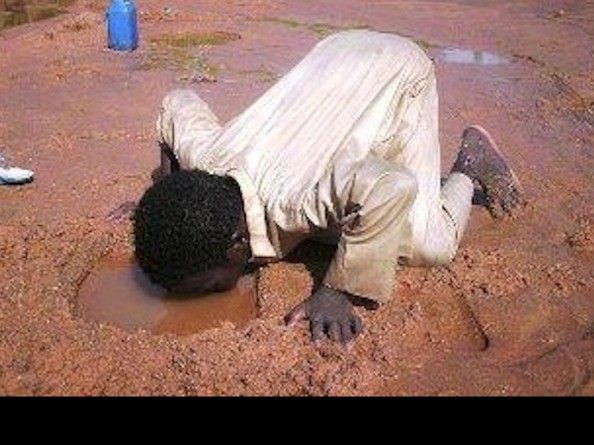
Why should children drink this way?

Sanaba is a new aid agency based in Houston Texas, USA. They have put together a fundraising page to help provide clean water in rural areas of the Red Sea State in Sudan. They hope to raise $15,000.
In an effort to encourage hygienic practices and to reduce the incidence of water-related illnesses, SANABA plans to acquire and install portable water filtration systems in rural areas of Sudan. From these wells, clean drinking water will be made available to students attending the community center, as well as to members of the public at large.

Our initial plan is to create a means of distribution of clean water in specific locations for the people in the community near our educational center. The first major consideration is a strategic plan to lay the ground work for wells to be identified, maintained and secured. The plan extends to educating the people in the community about the project, and is vital to any program.

Read about the fundraising program.

June 8, 2012

More electricity projects in eastern Sudan


Kuwaiti Extends $200m Loan for Electricity Projects in Eastern Sudan
Khartoum - The Executive Director of the Fund for Rehabilitation and Development in Eastern Sudan, Engineer Abu-Obieda Mohamed Duj, has announced completion of studies and designs on electricity projects in eastern Sudan, praising the State of Kuwait for its commitment during the Donors Conference for Eastern Sudan Development.
 
Engineer Duj affirmed during a meeting at his office Monday with the visiting mission of Kuwaiti Fund for Arab Economic Development that the work in the project would begin before the end of the current year, asserting the full coordination between the fund and the parties concerned with implementation, supervision, operation and maintenance.
 
He touched on the positive impact of the project and the development progress that would be realized following establishment of the lines carrying electricity and connecting them with the lines coming from Sinja, Siteit and Meroe Dams, in the fields of housing, agricultural and industrial sectors in the three states of eastern Sudan.
 
Meanwhile, member of the mission and the Legal Advisor of the Fund, Nawaf Abdallah Al-Mahal, announced completion of the administrative procedures for the initial signing of the loan agreement for financing of electricity project for the eastern Sudan scheduled for next week at 57 million Kuwaiti dinnars (about 200 million dollars), praising the high professionalism of the staff of the Fund for Rehabilitation and Development of Eastern Sudan in preparation for feasibility studies and engineering designs.
__________________
Sourced from prolific blogger Lady Gaga at Skyscraper City.

In other news,
Kennan Sugar Company and ERIDANIA one of the biggest Italian sugar companies will sign soon an agreement to erect a Sugar Refinery in Port Sudan for export, an investment that is estimated to reach about $130 million and considered one of the biggest European investments in Sudan...

June 7, 2012

Analysis: Aid NGO expulsion


Further discussion has been posted at Enoughproject.org   [Khartoum’s Pattern of Neglect Continues in Eastern Sudan as Government Expels Aid Groups  June 5, 2012]

 Selections:
The decision last week by the Sudanese Humanitarian Affairs Commission, or HAC, to suspend projects in the deeply impoverished East is yet another example of Khartoum’s continued pattern of obstruction and neglect of peripheral areas.
Though rarely in the international news headlines, the East has been plagued by similar patterns of discrimination and disenfranchisement as the other peripheral areas of Sudan. The East has shockingly poor humanitarian indicators, largely the result of Khartoum’s sustained neglect.
Until a comprehensive strategy to promote inclusive constitutional reform and democratic transformation for all communities within Sudan is adopted Khartoum will continue to use humanitarian aid, and the lives of those dependent on it, as a political tool.

Read the complete article, it's not too long.

June 3, 2012

Beja Congress deplores explusion of aid agencies


The Beja Congress has responded to the federal government of Sudan. Seven NGOs have been told to stop work in east Sudan for 30 days, as reported yesterday on the blog.

Here is the Press Release from the Beja Congress as found on sudan eyes. Originally available at Sudanese online .

= = = = = = =
The so called Humanitarian Aid Office (HAO) in Khartoum announced the expulsion of seven humanitarian aid organizations from eastern Sudan, claiming their violation of the obligations of voluntary work. These includes Save the Children of Sweden, the Irish GOAL, Accord and NATs Roche and the Japanese Plan Sudan.

The HAO has threatened that the government would not tolerate any slip of the organizations to the security laws.

This is not the first time that the authority expels humanitarian organizations from rural areas of the East, it has already expelled all aid organizations in its early years of its seizure of power in 1989, and during and after the war of liberation.

But under strong pressure from the international community, the government allowed the return of these organization. It is known that these aid organizations work to provide primary health care and the provision of food aid in the far remote rural areas, where there is no trace of any governmental care.

These organizations submit their reports regularly to the authorities, as agreed upon.

But the reports indicate that the humanitarian suffering continues to increase. Diseases like TB, anaemia, malnutrition and diarrhea are rising, which results in the increase of mortality, especially among children and women.

The decision to expel humanitarian aid organizations from the states of the East, is highly irresponsible, and would result in the increase in humanitarian sufferings in the remote areas of eastern Sudan, which are particularly impoverished, poor and underdeveloped.

The government is not even putting in consideration to access these regions for inspection, not speak of development. They are beyond its scope of horizon.

The expulsion of the aid organizations that only operate in eastern Sudan, where they are dearly needed, amounts to genocide through starvation.

Beja Congress deplores and strongly condemns their expulsion and calls upon all the activists in the health services, clergy, community leaders, students and all youth organizations and members of political organizations to enforce the return of these humanitarian organizations.

Beja Congress appeals appeals to the international community and especially to the United Nations, the European Parliament, the Organization of African Unity and all democratic organizations to exercise the necessary pressure on the government of Sudan to allow the return back of these organizations.

http://www.bbc.co.uk/news/world-africa-18296430

Dr Abu Amna
Beja Congress leadership

Alternate source of press release on Sunday, June 3, 2012, at https://www.facebook.com/BejaCongressUK


The BBC article linked above reads, in part:


At least four aid organisations have been banned from working in the deeply impoverished eastern region of Sudan, sources have told the BBC.

An official at the Humanitarian Affairs Commission (HAC), who asked not to be named, told AFP the non-governmental organisations being told to stop working in the east were Save the Children Sweden, GOAL of Ireland, a Japanese humanitarian group and another Irish organisation.

"The HAC decided to expel four international NGOs working in eastern Sudan because they failed in their planned projects," the HAC source told AFP.
 
The head of one of the organisations concerned told the BBC he was intending to appeal against the decision.

An unnamed Sudanese official told the AFP news agency the aid groups had "failed in their planned projects".

A BBC reporter says Sudan has in the past restricted the work of foreign humanitarian agencies, accusing them of working to destabilise the country.

Fears of fresh rebellion
The BBC's James Copnall in Khartoum says eastern Sudan is a particularly sensitive subject for the Sudanese government at the moment because there are fears that a rebellion could break out again. The area is made up of Red Sea, Gedaraf and Kassala states. But the region is particularly poor and underdeveloped region.

In 2010, donors and investors pledged more than $3.5bn (£2.2bn) to eastern Sudan at a conference in Kuwait - but frustration is growing because many of its people say they have not seen the benefits of that pledge or the peace deal, our correspondent says.

The activities of the aid groups elsewhere in Sudan have reportedly not been restricted.

In 2009 President Omar al-Bashir was indicted by the International Criminal Court for crimes allegedly committed in Darfur, in the west of the country.

The next day 13 aid organisations were expelled from the country. Senior Sudanese officials often accuse aid workers of collaborating with the ICC, and unnamed "foreign powers", our correspondent says.

June 2, 2012

Aid agency work halted in east Sudan


Seven foreign aid agencies working in east Sudan have had their operations halted for 30 days by the federal Sudanese government.

The aid and development groups concerned by this decision include Accord, Goal [Ireland], Triangle, save the Children [Sweden], Plan Sudan, Malo, a British demining group, and a Japanese aid
group. Several other non-governmental organizations [NGOs] are not affected.

Sometimes feeling threatened by the activities of NGOs, Sudan has a periodic history of ill-will toward aid agencies, having previously kicked out agencies in the east, and in Darfur. They are currently preventing aid agencies from delivering food in southern Kordovan, near the border with South Sudan.

Sudan faced international condemnation when it expelled 13 leading aid groups including Oxfam and the U.S. branch of Save the Children in March 2009, accusing them of passing information to the International Criminal Court.

From allafrica...

Khartoum — Sudan's Humanitarian Aid Commission (HAC) has ordered seven foreign aid groups to suspend their humanitarian activities in eastern Sudan following the findings of an assessment study reporting infractions they allegedly committed.

Sudan's Humanitarian commissioner Suleiman Abdel Rahman on Thursday issued a decision ending the humanitarian activities of the seven aid groups in the three states of Eastern Sudan region: Kassala; Red Sea and Gadaref states.

The ban was based on a report prepared by a federal committee that conducted a field assessment of the projects implemented by these groups.

The aid groups concerned by this decision include Accord, Goal, Triangle, save the Children, Plan Sudan, Malo, a British demining group, and a Japanese aid group.

The officer of voluntary activities, at the ruling National Congress Party (NCP) Ammar Bachari stated Thursday that foreign aid groups in eastern Sudan exceeded their license and roles. He further expected a decision by the Presidency of the Republic to expel it during the next few days.
However, HAC chief in his decision gave these groups one month to reconcile their position. If they fail the authorities will not renew their licenses and they have to stop their activities.

Earlier in May, addressing a rally organised in Port Sudan to provide support to the Sudan Armed Forces (SAF) Sudanese presidential assistant Nafie Ali Nafie denounced call for the return of NGOs to South Kordofan and described them "trumpeters of conspiracy".

"Those who covet that foreign aid groups have a foothold in the East (Sudan) they should know there is no place for them," he further said.


Another article from Reuters.
Some agency sites with information about their work in Sudan...


http://plan-international.org/where-we-work/africa/sudan/where-we-work/kassala

http://www.goal.ie/Sudan/173

http://www.savethechildren.org/site/c.8rKLIXMGIpI4E/b.6150471/

http://www.trianglegh.org/English_TGH/html/Programmes/MissionsHumanitaire/Sudan/SudanREA_gb.html


May 28, 2012

Excellent analysis of situation in east Sudan


Conditions in rural east Sudan are very poor. Why are other Sudanese and those in the international community unaware of such conditions?

[We think] that near-complete lack of media coverage and documentation, high illiteracy rates in rural areas, and lack of skills among newer generations due to low levels of education, are all factors contributing to this obscurity and lack of information.

Furthermore, the rapid expansion and development of the larger and central cities of the East reflect a false impression about the actual situation in the region. Port Sudan is an ideal example of the blatant contradiction between the city and the huge surrounding tin towns the margins, and the rural areas of the Red Sea in general.

Thus, the goal of this article is to draw attention to what many are oblivious to in East Sudan, and to provide a database that will serve to direct research efforts towards these issues, with the main target being civil society as well as media, both inside and outside Sudan.

The article is divided into a prelude followed by nine points which are as follows:

1.    Threats to stability in the East
2.    The implementation of the East Peace Agreement
3.    Human rights in the East
4.    The main active powers in the region and their influences
5.    The tribal system
6.    The Egyptian and Ethiopian invasion of Halaib and Al Fashqa
7.    The case of East Sudan in the context of Sudan’s other crises
8.    The relationship with neighboring Eritrea
9.    Recommendations for the national and international civil society, and media in dealing with East Sudan’s Crisis.


Read it all.


May 21, 2012

Iran to establish eight factories in eastern Sudan

Khartoum (smc), 13 May

Reconstruction and Development Fund for eastern Sudan, has signed an agreement with Iranian based Farsat Company, to establish eight factories, in the three states of eastern Sudan region, worth US$72m.

Minister of state for presidential affairs, and executive manager of eastern fund , Abu Obeida Mohamed Duj , told (smc) that the agreement, includes animal slaughtering facility, export city in Red Sea state; fruit canning factory , export city ,diary farm in Kassala; tannery and glucose factory in Gadarif state. Moreover, according to the minister, a proposal for building sugar factory in New Halfa has been also, included in the Iranian meeting minutes. It notes that, the agreed upon factories, were initiated in the context of donor conference, held in Kuwait, for developing the eastern region.

http://smc.sd/eng/news-details.html?rsnpid=36005

May 11, 2012

Gold mine needs 165 km water pipeline


To improve production of gold, a $44 million water pipeline needs to be constructed from the Nile River to the mine located about halfway between Atbara and Port Sudan. The Hassai gold mines in in the Red Sea Hills west of Port Sudan are running out of traditional ore.

Gold has been retrieved from the ore using the traditional heap leaching method. This involves pouring cyanide through many tons of crushed rock. Gold will dissolve in cyanide and a chemical process can then remove the gold from the cyanide. Gold bars are poured on site.

Diggings at the 16 open pit mines are almost complete. In 2011, 71,730 ounces of gold were retrieved. Using this standard cyanide method, the mines will be mostly depleted by the summer of 2014. For 2012, the company expects to extract 55,250 - 60,000 ounces of gold.

Canadian based La Mancha company owns 40% of the mine, and directs the mine operations. They have a plan to use a different technology to extract more gold from the tailings. This involves the application of electricity and water in a new plant to wash the dirt, thus retrieving the final grains of gold that were not captured by the cyanide method.

Using this VMS technique, the mine expects to produce 160,000 ounces of gold in the first year, once the machinery is in place. It will take about four years to go through all 12 million tons of dirt. This method allows them to extract more from the bottom of the existing pits as well. The three tested mines show promise, so the company thinks operations could run for 20 more years.

Water permits have already been approved, and the company expects to begin 18 months of construction "as soon as ownership discussions are completed with State of Sudan." The Sudanese Minister of Mines is on the leadership team or the Board of Directors of the company operations. Funding for expansion will be be completely supplied by the company. They need a plant for machinery and operations [$83 million.] They need a 165 kilometer water pipeline to bring water from the Nile River to the mining site in the Nubian Desert [$44 million.] Electricity is required, and so it will be taken from the existing line that runs to Port Sudan. A new electrical supply line will need to be built to get to the mine site [$18 million.]

Details of the current company operations are available in the corporate presentation [April 2012.]

We previously offered some details of this project in a post about six months ago.

May 2, 2012

Construction projects in east Sudan

A few large road construction projects have just been announced. With the loss of oil income, Sudan is aggressively pursuing enlarged agricultural efforts. To support the vegetable production in the Tokar region, studies for establishing a tomato canning plant are underway.

A loan agreement with Morocco will provide $200 million, to improve 420 km of roads in east Sudan, and to construct 3 bridges in the region.

In the Tokar region, mesquite trees need to be removed to allow increased vegetable and millet production. The European Union is helping support the plans for a vegetable canning factory.

Also in the news...
About cotton production...

Over the entire country, production of cotton in 2008 was only one tenth of the volume in the 1990s. Plans are to increase the number of acres of cotton production.
Growing season     # of feddans in production
2011-2012             0,400,000
2012-2013             0,800,000
2013-2014             2.200,000
one feddan is almost the same as an acre of land.


April 16, 2012

Book about Hadendowa women


Just found this one, though the book was published in 2007...
From the publisher's website...

In the Red Sea Hills of eastern Sudan, where poverty, famines, and conflict loom large, women struggle to gain the status of responsible motherhood through bearing and raising healthy children, especially sons. But biological fate can be capricious in impoverished settings. Amidst struggle for survival and expectations of heroic mothering, women face realities that challenge their ability to fulfill their prescribed roles. Even as the effects of modernity and development, global inequities, and exclusionary government policies challenge traditional ways of life in eastern Sudan and throughout many parts of Africa, reproductive traumas–infertility, miscarriage, children's illnesses, and mortality–disrupt women's reproductive health and impede their efforts to achieve the status that comes with fertility and motherhood.

In Embodying Honor Amal Hassan Fadlalla finds that the female body is the locus of anxieties about foreign dangers and diseases, threats perceived to be disruptive to morality, feminine identities, and social well-being. As a "northern Sudanese" viewed as an outsider in this region of her native country, Fadlalla presents an intimate portrait and thorough analysis that offers an intriguing commentary on the very notion of what constitutes the "foreign." Fadlalla shows how Muslim Hadendowa women manage health and reproductive suffering in their quest to become "responsible" mothers and valued members of their communities. Her historically grounded ethnography delves into women's reproductive histories, personal narratives, and ritual logics to reveal the ways in which women challenge cultural understandings of gender, honor, and reproduction.


The author is assistant professor of women's studies and Afro-American and African studies at the University of Michigan, Amal Hassan Fadlalla. This book was published by the University of Wisconsin Press

It's possible to read much of the book on google preview. 

April 14, 2012

Higher dam at Arba'at?


 Satellite photo of the dam region. Two portions are shown, only one is holding water. At the right edge of the black lake is a two part dam, but there is another dam to the left, with a white concrete spiillway. North is at the top. Water flows from the left side [west] to the right side[east] of the photo. If you click on the photo, you can see numerous earth dams to assist in irrigating fields. Search google maps for more. This location is about 12 miles west of Arb'at, Sudan.

A single source (with an unclear date) has stated that a deal has been signed between Sudan and  a Korean construction company to heighten the Arba'at Dam which is 40 km northwest of Port Sudan.
The report says,
Irrigation Minister Kamal Ali said the dam heightening, to be jointly undertaken by Kim Company of South Korea and Danfodio company of Sudan, will raise water output to 15 million cubic meters, enough to meet the city's daily demand.
The project is estimated to cost 4. 5 million dollars.
National Water Corporation's director, Mohammed Hassan Ammar said during the signing ceremony Monday that the dam would enhance the environment of the region and increase its agricultural output. 

Evidently this plan or a similar one has been in planning stages for many years. In the book, Climate Change and Adaptation Volume 1, [earthscan, 2008] Neil Leary points out that
Heightening of the dam is expected to divert more water for urban use in the capita city of Port Sudan to alleviate severe water shortage during summer time. But increasing water storage in the dam and diverting more water to Port Sudan will reduce the volume of water spillover that supplies the Arbaat community. Potential adverse effects of reduced water supply to Arbaat include reduced cultivated area, displacement of families, spread and invasion of aggressive mesquite trees into fertile agricultural land, and reduced production of food for subsistence and marketing to urban dwellers in Port Sudan. members of the Arbaat community are petitioning the government through traditional and religious leaders to either take necessary measures to mitigate the adverse impact of the project or, preferably, to drop the idea.

SOS Sahel is a non-governmental agency that was working in the coastal region north of Port Sudan. In their 2008-2009 annual review [page4], they commented on efforts to improve farming in areas downstream of the Arbaat dam.
Our work with traditionally conservative and marginalised Beja communities in Khor Arba’at, Red Sea State, has continued to focus on enabling the Beja to take control of their own livelihoods – through direct provision of tools, seeds, and infrastructure, and through training and community development. We have used earth-moving equipment to rehabilitate 24km of water diversion terraces and 5km of the Hanoiet dam in the Khor Arba’at delta. These water structures have enabled rain-fed irrigation of a larger area of farmland, increasing crop production. We have also provided certified seeds and agricultural tools to 318 of the poorest families – typically, those that are female-headed – and training in skills such as the use of fertilisers and pesticides.
Our work with Beja women to improve their literacy and numeracy and their awareness of gender and health issues has resulted in women reporting to us an increase in their status and confidence. We have also observed increased food production, and a shift from traditional crops such as sorghum and watermelon to ‘cash crops’ such as tomatoes and aubergines, which can be sold in Port Sudan; this has provided the Beja women, in particular, with a means to earn income, which they are able to invest in education and healthcare for their families. An unexpected and positive outcome of this programme has been the return of migrants from urban Port Sudan to rural Khor Arba’at, demonstrating that improving rural livelihoods can reduce levels of urban destitution.

Donkey cart carrying pupils to Kissibyai School, Khor Arba'at [SOS Sahel photo - January 2008]

Education in Khor Arba'at, in the Red Sea State of Sudan, is limited. Boys were having to walk many kilometres to get to their nearest school, and there was no school for girls.

In 2006, SOS Sahel UK set up the only girl's school in the area - Kissibyai School - which also accommodates boys in a separate classroom. To help the pupils attend school regularly, and ease the concerns of parents, we organised a local donkey & cart owner to become the school bus. He is paid monthly from families of the pupils. As a result, regular school attendance has been maintained, especially for girls.


February 7, 2012

Sudan budget - $40 M for the east


 Farmers in Tokar region [UN Environment]

The Minister of Finance and National Economy and Chairman of the Board of Director of the Fund for Rehabilitation and Development of East Sudan, Ali Mahmoud, disclosed the assignment of 40 million pounds in the general budget of the fiscal year 2012.

This came during the minister's meeting with directors of the fund administrations in the presence of the Walis (governors) of the three eastern states.

He indicated that the fund will receive support of the expertise of the Ministry of Finance to help attracting more loans for implementing development projects in east Sudan.

The minister also revealed the assignment of 50 million dollars from the Jeddah-based Islamic Development Bank for the rehabilitation of Halfa Agriculture Scheme, besides the assignment of another 50 million dollars for the rehabilitation of Toker Delta Scheme.

Meanwhile, the State Minister at the Presidency of the Republic, the Executive Director of the Fund for Rehabilitation and Development in East Sudan reviewed the performance of the fund and the projects implemented in the three states of east Sudan in the field of water, electricity, education, besides the implementation of projects through the donors mechanism in the three states.

The implemented projects include the establishment of 16 rural hospitals, and bridges dams in al Gadarif State and water desalination stations in the Red Sea State, filtering stations, and underground water wells in Kassala State.


COMMENT: We note that this budget item is not really new money, since the Khartoum government has previously promised $600 Million, but not paid it. They have made promises before, and not fulfilled them. Still, we are hopeful that these funds will be spent in a way that will help meet the needs of the poorer inhabitants of the east, and not line the pocketbooks of those people already wealthy.

The $100 Million for the agricultural developments is generous, and we hope it will make a real difference for improved land use and better crops. These funds are presumably part of the grants or loans that were pledged at the Kuwait Donors Conference.

Sourced from Sunanews.net

Related articles:
http://adroub.blogspot.com/2011/10/50-million-in-2011-for-agriculture-in.html

http://adroub.blogspot.com/2011/03/interview-with-dr-amna-dirrar.html

January 26, 2012

Sudanese Feds to complete peace agreement


 Ali Osman Mohamed Taha [sudaneseonline.org]

The Sudan News Agency reports that The First Vice President of the Republic, Ali Osman Mohamed Taha, has affirmed the state's support to complete implementation of Eastern Sudan peace, besides pressing ahead with the implementation of development and services projects.

This came when he met Tuesday with the Assistant of the President, Musa Mohamed Ahmed.

The Assistant of the President of the Republic said that the meeting reviewed the efforts being exerted to implement the remaining items of Eastern Sudan peace agreement, announcing that agreement was reached to hold a meeting of the Higher Committee for Implementation of Eastern Sudan Peace on February 20.

He pointed out that the meeting also discussed the political situation in the country, particularly with regard to preparation for the permanent Constitution, stressing the importance of contact with the political forces to realize national consensus on the Constitution.

http://allafrica.com/stories/201201251017.html

January 23, 2012

Disillusion and poverty in Sudan's east


 Typical street in east Sudan [2009]

An AFP report analyses the situation in east Sudan.

Disillusion reigns in Eastern Sudan more than five years after a peace deal with the government promised the poverty-stricken region a share of power and wealth.

Residents, including former rebels, say they struggle to survive and the region is tense despite an October 2006 deal which ended more than a decade of low-level insurgency against the Arab-dominated Islamic regime in Khartoum.

The Muslim non-Arab Beja ethnic group, camel herders by tradition, fought alongside the Rashaida tribe against what they said was government marginalisation.

Their complaints echoed a more high-profile conflict on the other side of the country in Darfur.

"I'm disappointed, disappointed, disappointed," said former rebel Hassan Dieken, 33, who is jobless.
"I believe only 25 percent of the peace agreement has been implemented."

[Click the title for the full story]

December 29, 2011

Review - Situation in East Sudan

There has been a number of developments in East Sudan over the past few months.

With deteriorating harvest conditions, a humanitarian crisis is developing. The central government in Khartoum continues to refrain from developing the eastern part of the country. Political groups from around the country have banded together to seek regime change through political and possible military action.

The progressive news media source, Al-Akhbar.com, based in Beruit, Lebanon has published a review of developments in East Sudan, with a focus on the Beja participation.

AS THE humanitarian crisis in eastern Sudan reaches alarming levels, past allies have banded together again to demand development in impoverished region
More than ever, Eastern Sudan seems ready for its revolution “against marginalization.”
Locals of the region are once again gathering their weapons. Political leaders in the eastern region assert that they are ready to make choices in order to eliminate the injustices brought upon them, especially with regard to the deteriorating humanitarian condition that has now reached its worst levels. etc. etc.

Read the file online. Download a pdf. Original, in Arabic.

December 20, 2011

ANALYSIS: Tourism in east Sudan not doing so well


 A general view of old Suakin, in the Red Sea state, October 10, 2011. Source: REUTERS/Mohamed Nureldin Abdal. Found at SkyscraperCity. 

Waiting for a better day on the Sudanese riviera

It has a coastline legendary for its diving, nomadic culture and an ancient island port with houses built of coral, but Sudan's Red Sea is proving a hard sell, despite Khartoum's high hopes.

On the corniche in Port Sudan, youths play snooker, smoke water pipes and watch cargo ships unloading in the docks, during a mild evening in early December, peak season for the country's top holiday destination.

There is barely a foreigner in sight.

Diving boats serving the more adventurous holidaymakers are moored in the harbour, waiting to explore the rich marine life, spectacular shipwrecks, or the remains of French oceanographer Jacques Cousteau's bizarre experiment in underwater living.

Lorenzo Orso, who runs the Don Questo diving ship, says he's been losing money ever since 2009, when the global economic crisis hit, and the International Criminal Court charged President Omar al-Bashir with crimes against humanity in Darfur.

"In the last three seasons we're just trying to recover our costs. Sudan has been facing various troubles. After the separation, we also had all the problems in Egypt, so people were afraid to fly through Cairo," he said.

South Sudan seceded from the north in July, taking with it 75 percent of the county's oil production -- exported via pipeline terminals just south of Port Sudan -- and forcing the cash-strapped government to frantically cast around for other sources of income.

The then deputy minister of tourism Ali Mahjub Atta was quoted by state media in September as saying that 550,000 tourists visited Sudan last year, generating total revenues of $616 million.
In the same period, 15 million holidaymakers travelled to Egypt.

Atta forecast that the number of tourists visiting Sudan, along with tourism receipts, would rise by 20 percent in 2011, with the political turmoil in other Arab countries encouraging them to choose "more secure" destinations.

But instead, it is an abject lack of security that comes to the minds of most westerners when they think about Sudan, as Imran, a Sudanese woman running a resort 30 kilometres (18 miles) north of here, admits.

Other factors blocking Sudan's growth as an international holiday destination include the Islamist government's ban on alcohol and US sanctions that prevent the use of Western credit cards -- which Rowida Farouk, assistant manager of the Coral Hotel, Port Sudan's finest, describes as a "disaster." But rich rewards await those determined to visit the Sudanese coast, both above and below the water.

Some 30 kilometres south, past the tents of Beja camel herders, one of Sudan's most distinctive indigenous ethnic groups, lies the mysterious island of Suakin. A gateway for African pilgrims travelling to Mecca down the ages, Suakin was also a thriving trading port during the era of the Ottomans, whose houses were built of coral blocks.

A Turkish company is finally restoring some of the ruined Ottoman buildings, while the village on the mainland, El-Geyf, is a hive of Beja activity, with its bustling market, its sword-clad men and its stray goats roaming the dusty streets.

Louay, the manager of Port Sudan's Palace Hotel, says the state's governor, Mohmed Tahir Eilla, has done a huge amount to open up the region, including lifting the need for a permit to travel outside the city last month.

"Since his appointment in 2006, the governor has changed everything... He's doing his best. But he's tied with a very limited budget," he says.


Read the complete article ...
http://allafrica.com/stories/201112191846.html or
http://www.rnw.nl/africa/bulletin/waiting-a-better-day-sudanese-riviera

For another story about tourism in the east, here's one published a couple of months ago. View the thread for more pictures of the reconstruction of Suakin.
http://www.skyscrapercity.com/showpost.php?p=85083288&postcount=1

Oh my, we already covered this story in October.