Showing posts with label history. Show all posts

December 22, 2012

Display of colonial Sudan in Durham, UK


http://www.soas.ac.uk/gallery/disappearingheritage/full75420.jpg

British and Egyptian flags flying in front 
0f a motor carriage used during the visit 
to Khartoum of Khedive Abbas Hilmi II. 
Photograph by R. Von Slatin, 1901


A series of photographs that capture the disappearing elements of Sudanese development in the 20th Century will be on display at Oriental Museum of the University of Durham, from January 1 - March 1, 2013.

Many culturally important buildings built during the rule of the British are slowly deteriorating due to neglect of maintenance.  They have been reused for other purposes. Some of the railway buildings have been abandoned to the desert. Frederique Cuventas captured many photos during a six year period up to 2010.

The exhibit is called: Disappearing Heritage of Sudan, 1820–1956: Photographic and Filmic Exploration in Sudan. It documents the remnants of the colonial experience in Sudan from the Ottoman, Egyptian and British periods.

This exhibition has previously been shown at the Brunei  Gallery at the University of |London, UK. For a few months, starting in September 2013, it will be shown at the University of Khartoum.


July 11, 2012

Ancient Beja - The Blemmyes


Many forums that look at the history of ancient Egypt touch on the role of the people who lived on the southern border of Upper Egypt. An excellent survey of the Blemmye people is republished below, part of a longer post that included discussion about the Aksumite people. The entire thread might be worth a look.

Posted by Mace1.
The Blemmyes (Latin Blemmyae) were a nomadic Nubian tribe described in Roman histories of the later empire. From the late third century on, along with another tribe, the Nobadae, they repeatedly fought the Romans. They were said to live in Africa, in Nubia, Kush, or Ethiopia, generally south of Egypt.

In antiquity
The Greek geographer Strabo describes the Blemmyes as a peaceful people living in the East Desert near Meroe.

Their cultural and military power started to enlarge to such a level that in 197 Pescennius Niger asked a Blemmye king of Thebas to help him in the battle against the Roman Emperor Septimius Severus. In 250 the Roman Emperor Decius took a lot of effort to win over an invasion army of Blemmyes. A few years later, in 253, they attacked Lower Aegyptus (Thebais) again but were quickly defeated. In 265 they were defeated again by the Roman Prefect Firmus who later in 273 would rebel against the Empire and the Queen of Palmyra Zenobia with the help of the Blemmyes themselves. The Roman general Probus took sometime to defeat the usurper and his allies but couldn't prevent the occupation of Thebais by the Blemmyes. That meant another war and the almost entire destruction of the Blemmyes army (279-280).

In the reign of Diocletian the province of Lower Aegyptus (Thebais) was again occupied by the Blemmyes. In 298, Diocletian made peace with the Nobatae and Blemmyes tribes, agreeing that Rome move its borders north to Philae (South Egypt, south of Aswan) and pay the two tribes an annual gold stipend

The Blemmyes occupied a considerable region in current day Sudan. There were some important cities like Faras, Kalabsha, Balana and Aniba, and they were all fortified with walls and towers of a mixture of Egyptian, Helenic, Roman and Nubic elements.

Their culture had also the influence of the Meroitic culture, and so, Blemmyes religion was centered in the temples of Kalabsha and Philae. The former being a huge masterpiece of Nubian architecture, where a solar lion like divinity named Mandulis was worshiped. Philae was a place of mass pilgrimage with temples for Isis, Mandulis and Anhur, and where the Roman Emperors Augustus and Trajan made many contributions with new temples, plazas and monumental works.

- - - 

With the death of Cleopatra in 30 BC, Egypt became part of the Roman Empire. The Roman attitude toward the nomads was very different from that of the Greeks: Repulsed by their wild-haired appearance, the Romans regarded them as scarcely more than another kind of desert beast, and treated them accordingly. The nomads began raiding Roman territory and trade routes. By the latter half of the third century of our era, the Blemmyes had united sufficiently to present Rome with a challenge. According to the fifth-century Palestinian historian Eusebius of Caesarea, the Blemmyes overran the Nile Valley in 268, from Syene (Aswan) all the way to Ptolemais, near modern Sohag, and it took the Romans years of bitter campaigning to drive them back into the desert.

From the third to the fifth centuries the Blemmyes continued to threaten Roman hegemony in the region. In his De Bello Persico, the sixth-century Byzantine historian Procopius recorded that in 284, Emperor Diocletian, faced with continuous Blemmyan conflict, formally relinquished to the Blemmyes jointly with the Nobadae, their rivals, a 250-kilometer (155 mi) stretch of the Nile known as the Dodekaschoinus, which stretched from Syene south to near the present Egyptian Sudanese border. In addition, Diocletian arranged to pay annual tribute to the Blemmyes, and he allowed them access to their favored shrine of Isis at Philae (near modern Aswan), as well as the right to have their own priests in residence there.

Although Diocletian's appeasement did not end Blemmyan raids, the Blemmyes did for a time respect the border at Syene. But by the latter half of the fourth century the Blemmyes were de facto rulers of the Nile Valley far beyond that point. In a contemporary letter, Blemmyan ruler Kharachen assured his administrators at Tanare (some 240 kilometers, or 150 miles, north of Syene, near modern Luxor), "If the Romans make difficulties and do not pay the ordinary tribute, neither the phylarch nor the hypotyrannos [Blemmyan authorities—the Blemmyan language of state was Greek] will prevent you from compelling the Romans to pay it." Interestingly, although the Blemmyes controlled much of the Upper Nile for nearly three centuries, they did not become a settled people. They remained desert-based throughout, interested only in dominating their peripotamian subjects.

The situation changed dramatically in 536, when Emperor Justinian outlawed pagan worship and ordered the removal of the idols at Philae. Outraged, the Blemmyes resumed their raids. Four years later, their hold on the Dodekaschoinus was broken—but not by Rome. Silko, the newly Christianized king of the northern nubian kingdom of nobatia, led an army north, and defeated the Blemmyes so thoroughly that they relinquished all of the Nile and retreated to the desert. The end of their hegemony marked the final blow to paganism in Christian Egypt.

Today, the descendents of the ancient Medjay are part of the Muslim Beja nation.

June 14, 2012

Historic description of Bisharin tribes


From The Anglo-Egyptian Sudan: a compendium prepared by the officers of the Sudan Government. Edited by Count Gleichen  Volume 1, 1905

Text was originally scanned- some spelling mistakes may exist...

The Bisharin

The Bisharin inhabit the desert bounded on the north, roughly, by the Alagi and its tributaries, on the south by the Atbara, on the east by the Red Sea from Shalatein to J. Asotriba, and thence by a Hne joining Mitateb or Umbeiba on the Atbara, and on the west by the Nile from the mouth of the Atbara to Abu Hamed, and thence by the old trade route from Abu Hamed to Korosko.

The Ababda and Bisharin formerly lived a good deal further south in the districts now occupied by the Hadendoas; both tribes moved northwards probably about 100 years ago.

The Ababda by their move north, came into a more civilised country. Their Sheikhs, through the transport needed on the Korosko—Abu Hamed road, came into touch with the Government and acquired at this time great wealth, and with wealth, their numbers increased, whilst the Bisharin of the hills, left far behind as regards progressiveness, soon came to be despised by them.

The Bisharin claim descent from Bishar, the son of Kahl, who was also the father of Abad and Amar, from whom the Ababda and Amarar are said to have sprung.

Kahl is said to have been descended from Zubeir Ibn El Awam,* whose wife was a sister of Abbas, uncle of the Prophet. They maintain, therefore, that they are descended from the noble Koreish Tribe. In the genealogy of the tribe, the three principal ancestors are Kahl, Bishar, and Ali Jalan; on this all accounts seem to agree. The present generation of Sheikhs is generally said to be the ninth or tenth from Ali Jalan.

The descendants of Kahl most likely originally inhabited part of the district now occupied by the Hadendoas, the Bisharin, and Ababda, as stated above, having latterly moved northwards.

The Bisharin are divided into two great families, the Um Ali and Um Naji. The former live in the north, the latter in the south, of their country. Both sections are named after the wives of Ali Jalan, the great grandson of Bishar, who had the following sons :—

Ali .. Shanatir Amer . Hamedor Aliab. Shantirab. Amrab. Hamedorab. Hanr . Eira . Nafi . Mansur
Hanr. Eireiab. Nafab. Mansurab.

Boundaries of Bisharin.
Aliab.— The Aliab, who are far more numerous and wealthy than any of the Um Ali or Um Naji tribes, are divided into the following sub-tribes : Koatil, Mallak, Hamedomerab, Kurbeilab, and Balgab.
The first three named are sometimes classed together and known as the Sararab, on account of their near common ancestry.

The Sheikh of the Koatil has for two generations been the representative Sheikh of these three families ; before this the Sheikhship was with the Hamedomerab.

Sub-tribes of the Aliab.
Koatil.— The Koatil, under Sheikh Isa Abdalla, are a small tribe, and poor. They live at Meshushenai and Terfaui.

Hamedomerab. —Sheikh Mohammed Wad Kurab. This, again, is a small tribe, owning few camels, but good flocks of sheep and goats.  Wadi Meisa, at the head of which is Bir Meisa, is where most of the tribe are to be found during the summer. Their two wells are Meisa and Didaut, close together in the small hills north of the Elba red granite range.

Mallak.— Sheikh Isa Shingeirab. The Mallak, the third Sararab tribe, is by far the richest, and own many camels, and of a breed which is famous among all the neighbouring tribes. The Mallak own many wells.

Balgab.— The next of the Aliab tribes is the Balgab (Isa Abdalla), who live in the hills about Is. They have never, since the time of Abdalla, the father of Isa, had a representative Sheikh, but have always been represented by the Sheikh of the Sararab. They have good herds of camels, sheep, and goats. They do not frequent the Aswan market as much as the other Aliab sub-tribes, but they sell a great deal to merchants who come from there, and buy much of their corn in good

* In spite of their claim to be of Semitic origin, the Bisharin are not true Arabs and are of Hamitic descent,...


Compensation for murder or wounds.

The traditional "diia" or compensation for loss of life among these Arabs is: for a man, 50 male and 50 female camels; for women or children, or loss of legs, arms, eyes, 25 male and 25 female camels.
Wounds are assessed according to their gravity. The cause in which murders are committed, or a wound is received, is always taken into consideration. The above amounts are the limit of compensation.

Get your own copy of this 412 page book.
This book is available for about $20.00 CAN from the University of Toronto print on demand book publishing program. Search here to order... Or get it for about $10 from the University of Pittsburgh.

June 1, 2012

PICTURES: Suakin from the air

Been collecting these for a while, and wanted to share them with you. A selection of items found on the internet, to show you about the building structures on Suakin, from the early 1900s onwards. All photos will enlarge when you click on them.

Location of Suakin, south of Port Sudan   (1958)


Location of Suakin, south of Port Sudan   (1958)


Suakin 1981. looking northwest. Photo by Daniel Seerberger.


Suakin close-up 1981. looking southwest. Photo by Daniel Seerberger.


 Suakin looking northwest. Photo by pomkomGRB

Local fishing boats on the island south of the causeway. Photo by pomkomGRB


Looking east toward shipping channel from minaret?.
Article and photos about restoration of Suakin at International Business Times. October 2011.


Looking southwest from the minaret? on the island. 
Article and photos about restoration of Suakin at International Business Times. October 2011.

Looking east from mainland to the channel to the Red Sea.
Source unknown. Date 1930? WWII-1942?


Looking west. Photo by Colonel Hubbert. August 17, 1930. [More info]


Aerial photo uploaded at Beja Tribes of East Sudan. No date. 1930?


Undated, found at the rich photo site Skyscraper City.
Looking southeast - Red Sea in distance.


Modern satellite view, from google maps. May 2012. Large 1 megabyte file.


The Cousteau ship Alcyone picks her way through treacherous reefs to the abandoned port of Suakin, a city built of the same coral that guards her entrance. Uploaded August 2008. Aerial photo looks old, from an earlier era.


Movie made by a tourist. Includes historic illustrations. Uploaded January 2011.


MORE!!!


Photos of buildings in Suakin. [in English at Skyscraper City.]

Website about Suakin, showing black and white photos of buildings and giving a very short history of the place. Exciting!

May 25, 2012

VIDEO: Summary of the Beja world


Uploaded about a year ago. Almost 8,000 views. Enjoy.

May 17, 2012

PICTURE: Hadendowa man - sepia


From a 1920's postcard selling on ebay...

May 14, 2012

The Hadrami people and the Beja people

The Hadrami people live in South Yemen, but thousands of them have moved to sites along the coast of the Indian Ocean and the Red Sea. Professor Leif Manger explored the Hadrami Diaspora, a $60 book published in September 2010. We offer some excerpts from the book.


Quick look at Turkish rule in the 1800's
Britain had watched the growth of Egyptian control of north east Africa under Mohamad Ali in the 1820's and 30's with concern. The regional developments played a role in its decision to occupy Aden in 1837. From Aden [in Yemen] the British could also keep an eye on Ethiopia, especially the important trading town of Massawa. But Egypt was the regional centre of power.
Khedive Islamil Pasha of Egypt, inspired by his grandfather, Mohamad Ali (died 1849), dreamed of creating an African empire. The proximity of the three trading centers of Suakin, Massawa, and Jeddah linked Africa to the Hijaz and the Muslim pilgrimage... [From 1863 Ismail Pasha secured control of the Red Sea region for Egypt and began administrative reforms.]

Soon they were developing plans for transport links, telegraph lines, and water works. The region suffered from a lack of health services, schools, mosques, and basic housing, so new systems of taxation and local administration were introduced.... Economic development was also promoted. Increased production of cotton and dura was a priority in areas that could be irrigated. The cultivation of such cash crops were introduced to areas such as the Tokar Delta, Gash and, in the south, Aqiq [beside the modern Sudan/Eritrea border.] Cotton was a priority in order to exploit international market shortages caused by the American Civil War.

Mining was another activity, as was salt, which was shipped to Jeddah to be resold to Indian boats. To better reach markets, improved transport between Sudan and Egypt became another priority. 

Egypt began to borrow from foreign sources. Times were exciting in Egyptian controlled regions. The Suez canal opened in 1869. Railways were built. Palaces were constructed. Coastal towns were improved.  Kassala had been established as an army outpost in 1840. But Egypt's ambition was greater than her capacity and funds.

Egypt had a war with Ethiopia in 1875-76. But Egypt lost the war.

In 1875, to manager her debt, Egypt was forced to sell its shares in the Suez Canal to Britain. Ismail was deposed. In the Soudan, the Mahdi declared his role in 1881, which became independent from Egyptian control after Khartoum was captured from General Gordon in 1885. During this tumultuous time, the British became more deeply involved in Egyptian affairs. Professor Manger writes:
It is during this time of general unrest and foreign occupation that we find the early migration of Hadramis.... The migrants travelled to Aden, the Red Sea ports of Jeddah and Suakin, as well as to Cairo. They went to Ethiopia, Somalia, and Kenya. Shipping was an important activity.
Trade in slaves was common; slaves were also commonly used as crew on the dhows. Trade in coffee to Egypt was important, as was the arms trade to Djibouti.

Less important trade items included millet and sesame from Somalia to the Hadramis home region in Yemen, and hides millet, and camels out of Massawa. Moneylending was also common, in which the Hadramis competed with Indians.

The Beja and Hadramis in Suakin
Suakin has a unique geography. As a very small island in a good harbour a clear difference existed between the inhabitants of the island, and those people living on shore. The island was an Indian Ocean merchant town with houses made of limestone and coral. The island is made of coral. The Hadramis have had a long association with the town.
The development of new buildings was slow until the building boom of the 1860s and 1870s, led by the policies of Khedive Ismail. The town of Suakin included two mosques, some warehouses, and coffee houses. There were few houses on the mainland, as the area was mostly inhabited by the Beja people who traditionally lived in semi-permanent huts or shelters. There was a mosque as early as 1822, according to Burkhart. While mainland culture was dominated by the Beja, the island's inhabitants represented Arabic culture, speaking Arabic and dressing like hijazis. The mainlanders spoke Ti-Bedawyet and wore traditional clothing.
On the island were "Turks" which included people from everywhere in the Ottoman Empire; and "Banyans" a term used for a group of non-Muslim Indians engaged in trade with India and also moneylending. The group included merchant castes from northern and western India (Sind and Gujarat), most of whom were Hindu but who could also be Jain. Finally there were also local elite religious groups like the Beja Hasanab and the Artega.
On the mainland, meanwhile, the inhabitants were Hadariba and Beja (Bishariyyin, Amarar and Hadendowa, collectively known as Sawakini). The Hadariba were related to religious elites among the Beja dating from pre-Islamic times and who claimed ancestry from Hadramaut in Yemen. It is unclear at what time this occurred, indicating a lack of  clear genealogy, and perhaps also that the term Hadariba is more of an ethnic label for people who advanced claims about Hadrami descent in general.  [pp. 69,70]

Goods and Trading in Suakin
In the early nineteenth century most of the trade from Suakin went to Arabia, with sorghum (dura) being the most important export item. The grain came from Kassala-Gedaref (Butana) and the Gash, but some also came from agricultural areas along the Nile.
 The Beja brought animal products mats, dom fruit, nabaq, camels, and a few cattle. Fishermen provided fish and some pearls. Slaves and gold made up the luxury goods together with ivory, tobacco, incense, gum arabic, ostrich feathers and eggs, horses ebony, and musk. Cloth was also traded.
Indian goods were among the imports, including textiles, spices, perfumes, ornaments, and rice. From Jeddah, traders imported household utensils, dates, onions, sugar, coffee, tobacco, iron, and steel. All imported goods went through customs in Suakin.
In 1822, Burkhart thought that Suakin may have had 3,000 on the island and 5,000 on the mainland. In 1853, Munzinger put the numbers at 6-8,000 and 10,000. But in 1905, after the Mahdi's rule and British/Egyptian recapture had devastated Sudan, only 490 houses were on the island and 300 properties on the mainland. Port Sudan opened in 1905 and Red Sea trade shifted there. Suakin swiftly declined, and the island was essentially a ghost town by the 1920's; without maintenance, many buildings began to collapse.

Roles were different for Hadramis and Beja
In the mid 1800's, the Hadramis had the international contacts, as their community was spread through East Africa, Yemen, Arabia and even India. Their local agents were everywhere.
From Kassala they bought butter, which they carried in a liquid state, and dura... The town also provided waterskins and other leather product. Mats were acquired  from various Beja groups, while the famous racing camels were obtained from the Bishariyyin, one of the groups within the Beja confederation. 
Imports from India, shipped through Jeddah included women's dresses and ornaments, Indian sugar, coffee, dates, and iron. The iron was used to make knives and swords treasured by the Beja. These goods were brought across the Red Sea by small boats run by Arabs. 
Sudanese goods came on the Berber-Suakin caravans, but also from Khartoum via Kassala. As the slave trade diminished, gum Arabic from the Kordofan region of western Sudan rose as an important export crop.
Grain was transported by the Hadendowa and marketed by the Hadariba. The trade in so-called luxury goods was in the hands of Arabs.
So the caravan trade was managed by the Beja, and the selling of goods by the Hadrami. Manger notes that "The Beni Amer have an aristocratic ruling class and claim Arab Hadramouti origin. The beni Amer were Islamized by Funj holy men, but only with the Khatmiyya did they really become Muslims."

Manger's book explores the Hadrami Diaspora on site, with stories from Singapore, Hyderabad, Sudan and Ethiopia. He analyses the difficulties of maintaining an ethnic identity when people are far from their homeland, and he even looks at the role of the west, and it's influence on the muslim world in the middle east.

Did you know? The Ottoman Empire outlawed slavery in 1857.

April 1, 2012

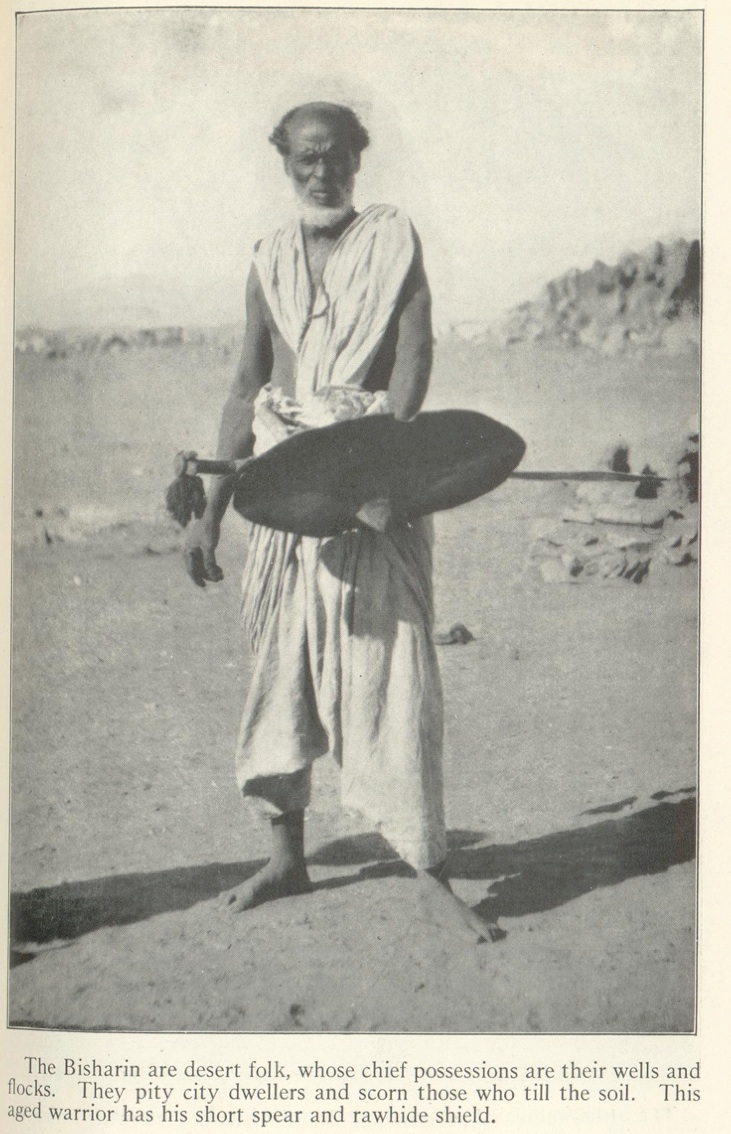
PICTURE: an older Bisharin warrior


Sourced from a United Nations World Digital Library. Cairo to Kisimu, by Frank Carpenter. page 220.

March 21, 2012

Classic history book reprinted!


First published in 1956 by Andrew Paul, a British administrator in Sudan, "The History of the Beja People" has been reprinted by Cambridge University Press, and should be available this month.

A very early review of this book was published in the academic journal "American Anthropologist" in 1956. (Volume 58. Issue 2. April 1956 (Pages 385 - 386)) Here is the complete review [or 2 page pdf download].


Mr. Paul is a British colonial administrator who served in the Sudanese Political Service from 1929 until, presumably, its end in 1955. Of natural interest to anthro- pologists because of its subject, his book is organized on a strictly historical framework, leaving the reader to pick up cultural details in transit. Nowhere before Appendix Two is one given a listing of the tribes which form the subject of the book, and information must be assembled piecemeal as to which tribes speak which of the three local languages; To Bedawie (Hamitic), Tigré, and Arabic. The maps fail to show many of the places mentioned. Interlarded with the narrative are provocative glimpses of the environment, material culture, family organization, and tribal structure-- glimpses which are never blown up into whole pictures. It is clear that Mr. Paul is capable of painting such pictures. He knows, understands, and respects his Beja, without glorifying, idealizing, or vilifying them. He writes easily and with a sense of humor. Now that the historians have been fed, let us hope that he will write a companion book of Beja ethnography.

While awaiting this work, we may gather from A History of the Beja Tribes that the Beja are a mixed bag of some 285,000 nomads and ex-nomads, popularly known as Fussy-Wuzzies, who inhabit some 100,000 square miles of territory barren in various degrees and lying between the frontiers of Egypt and Eritrea, and between the Red Sea coast and the hills flanking the Nile and its tributary, the Atbara River. Living off flocks of camels, goats, sheep, and in favorable places cattle, like most nomads they grow a little grain where and when they are able. Supposedly descended from an old Hamitic-speaking Caucasoid stock mixed with Arab, Tigré-speaking Yemenite, and Negro, they have achieved a striking and well-known racial appearance of their own. Like the Swiss, they speak several languages. Officially they are Muslims.
 The book’s theme is the sluggish stream of local history from the time of the shakily postulated appearance of the Bejas’ ancestors in the Sudan, in the guise of Neolithic pastoralists from the North, through Pharaonic, Ptolemaic, Roman, Axumite, Arab, Turkish, Egyptian, and British periods of influence to the paradoxical present. This history has seen the Beja shift religions several times, while certain tribes also changed their speech. It has witnessed the addition of new genes to their chromosomes, without marked physical change at variance with the needs of their special and highly selective environment. It has seen the addition of a new and particularly destructive beast, the camel. It has failed to record any basic change in Beja cultural attitudes. In 1955 they are just as rugged, individualistic, withdrawn, and completely self-centered as ever. Tell us more, Mr. Paul.

How to buy this book.
This book is printed one copy at a time, as orders come in. It costs about $35. In Canada, try here.

December 4, 2011

53 years of Beja Congress


Dr. Taha Osman Bileya, founder of the Beja Congress, 1958


A rally was held in Port Sudan on Saturday December 3, 2011 and 6,000 people attended the anniversary of the Beja Congress. Tribal leaders and Beja Congress officials, as well as representatives of political parties and civil society organizations were present. The event honoured men who have been working for the success of the Congress over the years and challenged the Beja youth to get involved.

Again the story was repeated that the Beja suffer from marginalization by the powers of government, and that the Beja, though significant in population, have very little access to sharing power.

Party leader Mousa Mohammed Ahmed gave a 3,000 word speech that reviewed the history of the Beja Congress, and the roles of many key people. He examined political developments, past and present.

Speech made by Mousa Ahmed in arabic. [10 page pdf]

UPDATE: [Dec 6] A full report of the anniversary was covered in the media. [arabic] [english machine translation]

October 21, 2011

August 27, 2011

Eritreans gearing up for September 1


Hamid Idris Awate, first leader of Eritrean freedom fighters.


The fiftieth anniversary of beginning of the armed struggle by the Eritrean people against their oppressive Ethiopian masters will be celebrated on September 1.

The armed struggle began in September 1961 when a contingent of eleven fighting men, under the leadership of Idris Hamid Awate formed the first armed forces of the Eritrean Liberation Front (ELF). Awate died in May 1962, probably as a result of battle wounds.

Eritrea had been federated to Ethiopia by the United Nations. Ethiopia tried to absorb Eritrea, which hoped for its own independence. Political parties were banned, publications were censored and languages suppressed. In ten years the institutions that might have encouraged Eitrean nationalism had been destroyed.

In 1962, steps were taken by Ethiopia to make Eritrea simply a province. By the spring, over 500 soldiers had joined the uprising. They harrassed Ethiopian soldiers near Agordat. ELF guerillas fought from the rugged Eritrean hills against Ethiopia. They nearly gained independence in 1978, but Russian  assistance to Ethiopia made it impossible.

Eritrea finally gained independence in 1993, now celebrated annually on May 24.


March 6, 2011

Forum: Racial heritage of Beja in Egypt


 Beja man on the Red Sea.

On the topic of "Beja, the closest relatives to the Ancient Egyptians," the thread starter states,

The presence of the Beja people can be traced as far back as pre-dynasty times; their proud and uniquely huge crown of fuzzy hair (tiffa) was first recorded in Ancient Egyptian rock paintings.

Egyptologist, Emile Brugsch traced the clan of the Khawr kiji Beja through the matriarchal Female line to the 20th Dynasty.


A series of photos are included.

See also more pics in another thread on EgyptSearch.

October 14, 2010

Anniversary of ESPA signing

The Eastern Sudan Peace Agreement was signed on October 14, 2006, four years ago.

November 26, 2008

Eastern Desert academic conference


A conference takes place in Cairo: the main lecture is titled "The History of the Peoples in the Eastern Deserts of Egypt and Sudan."

The region between the Red Sea and the Nile Valley in Egypt and Sudan is referred to as the Eastern Desert. The desertification of this region started with the end of the Holocene pluvial period and continues until today. The mobile hunter-herder-gatherers that left the region to settle in the Nile Valley are regarded as one of the driving forces behind the advent of Pharaonic civilization. Despite environmental degradation and scholarly neglect, the Eastern Desert has native inhabitants and a history of its own.

The mineral wealth in the Eastern Desert has attracted outsiders from early times onward, who in turn have been the focus of the attention of historians and archaeologists. The same is true for the trade routes that connected the Nile Valley with sub-Saharan Africa, Arabia Felix, India and the enigmatic Land of Punt. The study of the Eastern Desert is also hampered by the limitations of the historical sources, by the low archaeological visibility of the remains of the desert dwellers, and by ambiguous ethnographic parallels.

A conference organized by the Cotsen Institute of Archaeology (University of California, Los Angeles) at the NVIC aims to address the problems and possibilities of the study of the dwellers of the Eastern Desert, as well as to provide an overview of the current state of our knowledge. The preliminary conclusions of this conference will be presented in this Cleveringa Lecture. The region and its inhabitants, ancient and modern, also bring into focus some ethical issues, especially appropriate as this lecture was instituted to commemorate the courageous moral stance taken by Professor Cleveringa during the Nazi occupation of the Netherlands.