Showing posts with label Agriculture. Show all posts

June 6, 2014

Money for Tokar delta agriculture

Sudanese president Omer al-Bashir on Wednesday witnessed the signing of new agreements worth $100 million with the Islamic Development Bank (IDB) to fund three projects.

The projects include $50 million to finance the Delta Toker agricultural project as part of its previous pledges to the Eastern Sudan Reconstruction and Development Fund.

Also, there is $50 million for construction of an electricity carrier line between Babanousa and the third agreement deals with technical funding for the institutions for employment of youths.

Sudan's helped start the IDB which is currently celebrating its 40th anniversary. Sudan was the first country to contribute to the establishment of the bank.

The bank has extended $1.5 billion for construction of dams and other infrastructure projects in Sudan on recent years.

From All Africa

November 9, 2012

Herders and farmers clash in west Sudan


El-Geneina — During a meeting in El-Geneina, West Darfur on Thursday November 8, the High Committee for Protecting the Agricultural Season, headed by Abdullah Hamdan, adopted several decisions to solve the longstanding issues between farmers and herders, Radio Dabanga has learned.

The committee includes the national administration of farmers and herders, head Commissioner and Sultan of Dar-Massaliet, Saad Bahr al-Deen, as well as civil society representatives and government officials.

The decisions include prohibiting of early grazing, which will be implemented from 28 February 2013.
Furthermore, fines of 200 pounds will be imposed in case of deliberate trespassing and damaging of farms, the committee's chairman stated.

Additionally, a decision on a military or police intervention was adopted. The intervention will be requested in case of a dispute between herders and farmers that local commissions cannot resolve on their own, Hamdan added.

During the meeting, the farmers expressed their deep concern about the repeated attacks on their farms by herders and the trespassing onto their lands.


http://gmsudan.com/20121107/east-sudan-communities-in-europe-to-hold-exceptional-conference/

May 2, 2012

Construction projects in east Sudan

A few large road construction projects have just been announced. With the loss of oil income, Sudan is aggressively pursuing enlarged agricultural efforts. To support the vegetable production in the Tokar region, studies for establishing a tomato canning plant are underway.

A loan agreement with Morocco will provide $200 million, to improve 420 km of roads in east Sudan, and to construct 3 bridges in the region.

In the Tokar region, mesquite trees need to be removed to allow increased vegetable and millet production. The European Union is helping support the plans for a vegetable canning factory.

Also in the news...
About cotton production...

Over the entire country, production of cotton in 2008 was only one tenth of the volume in the 1990s. Plans are to increase the number of acres of cotton production.
Growing season     # of feddans in production
2011-2012             0,400,000
2012-2013             0,800,000
2013-2014             2.200,000
one feddan is almost the same as an acre of land.


May 1, 2012

Land use conflict example - Darfur


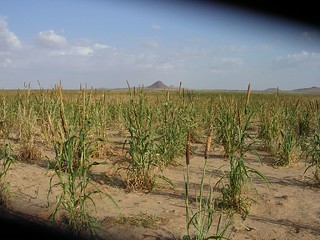
millet crops North Darfur

Millet crops North Darfur flickr photo [2004]


The rural countryside can lose it's grazing pastures as the dry season comes. Pastoralist herders need to move their animals to good pastureland. In Darfur, right now, the only land used to grow plants is for settled farmers.

What to do? What should the camel herder do? In this situation, they got out their guns.

Kireinick — Jjrbox farmers in West Amotjoke of Kireinick locality in West Darfur have complained of camel herders grazing in their farms and causing destruction by force of arms.

A farmer from Jjrbox told Radio Dabanga that the they had repeatedly tried to talk to the camel herders, asking them not to travel through the farms.

However they responded by opening fire and allowing their camels to graze. He added the police would not act when the farmers reported trespassing.

April 10, 2012

2 million acres in East Sudan for foreigners

The ministry of Agriculture for Sudan announced that 2 million acres of land in East Sudan will be made available to Saudi Arabia for growing crops for export.

The deal that Saudi Arabia has made with Sudan is very far reaching. The Arabians will be given exclusive control of the land in that they will not pay any taxes on the produce of the land- it is a duty-free zone. Additionally, Sudanese law will not prevail in the area; we assume Saudi law will be honoured instead.

Saudi Arabia imports food from countries such as Argentina and Australia. A programme to grow wheat in Saudi Arabia was abandoned in 2008. They are not able to be self-sufficient for their own food, but they would like to secure their own sources of supply. Saudi funded banks would ensure funds for businessmen who want to operate the farms.

It is not clear where this land is located. We would expect that adequate irrigation is available to grow crops so that would locate it in the Gash Barka delta or Tokar delta regions, or perhaps downstream for the new dams being reconstructed at Setit on the Atbara River.

It is not clear what Sudan gets in return for making this land available.

It is not clear how long the timeframe is for this deal.

It is not clear what impact this project will have on the local Sudanese.

Read the article at AllAfrica.

Ted Turner is the largest landowner in the USA. He owns about 2 million acres, equivalent in size to the island of Puerto Rico. That's about 3,100 square miles.


October 28, 2011

$50 million in 2011 for agriculture in east Sudan

The Islamic Bank for development has allocated the amount of $250 million USD for the rehabilitation projects of the agricultural sector in the three states of east Sudan within the context of the donor’s projects.

The executive manager of the east rehabilitation and development fund, eng. Abu Obeida Mohamed Duj, said the detailed study of the rehabilitation project of Halfa agricultural project rehabilitation has been completed and submitted to the Islamic bank for development for the approval of $50 million USD for the Year 2011 to commence the project’s work.

He added that the study will include the irrigation network axis, the agricultural research work and the veterinary services ,agricultural roads and introducing animals in the cultivation unit, providing the credit facilities ,the water connection for users, the social services, the institutional support, the legal situation and the project implementation unit.

He pointed that the studies were completed for rehabilitating Tokar and Algash projects and the work is continuing in preparing the detailed studies for the projects of developing the machinery cultivation in Gadarif and the horticulture cultivation in the three states, the studies will be presented to the bank every year for five years to approve each project alone annually.

Skyscraper City!

October 5, 2011

Famine? Food shortages; prices triple

"If the government does not do anything to solve the problem in the coming days, there will be a famine in eastern Sudan," said Salah Barkawin from Sudan’s Beja Congress party.

He said people in eastern Sudan were poor and could not afford sorghum, a basic food that has more than doubled in price.

"In August we warned the government to take care of eastern Sudan because of the rain shortage this year,” he told Agence France Presse news service. “Now the price of sorghum has risen to around 200 Sudanese pounds (that’s about £49) per bag, up from the normal price of 75 Sudanese pounds (roughly £18)."

A government official from Sudan's eastern region has acknowledged that the are serious food shortages there linked to the drought and said the government is sending food aid.

Noted on a UK charity site.

September 12, 2011

Same old, same old

Local inhabitants in South Kordovan complain of not being hired by oil companies.

Whenever large corporations move into a region to work on resource development, whether agricultural, mining or oil production, the hopes of local people are raised. Surely some compensation might come to them, even if it a fair trade of labour for wages.

Recent reports in allAfrica note that local people have not received labour jobs; people from Khartoum have come to work on the oil projects. Local people have had their land and farms destroyed by the oil companies as they build the pipeline to export the oil to market. And local people have complained that with the new national border in place, the cattle require additional care, yet watershed that they have asked for have not been built.

Sourced from AllAfrica.

August 24, 2011

Bashir looking for economic renewal


Since the Republic of South Sudan [RoSS] has declared it's independence, the leader of north Sudan has awoken to a new financial reality. The oil money is going, and soon will be gone.

For generations the revenue for the country of Sudan has come from the sale of agricultural products like cotton, sugar and gum arabic. When oil was discovered by Chevron in 1980, new possiblities opened up. An 1600 km oil pipeline was constructed from the oil fields across the country to Port Sudan. It opened in 1999.

The first eleven years of the 21st century belonged to Sudan. With new wealth that came from selling oil, Sudan aggressively pursued a building construction program for Khartoum, and the purchasing of military tools. The plan for Arabizing the country continued, with civil wars in the east, the south and the west, as minority groups resisted the marginalization, Islamization and destruction of their tribes and cultures.

In Sudan as a whole, oil sales revenue provided over 90% of the country's income during the first decade of the 21st century. This means that oil income was 10 times more than all the agricultural sales, which provided most of the income in previous years.

Sales of oil to China and other Asian countries provide $300-400 million US per month. After the Comprehensive Peace Agreement was signed, the income was split, about 2/3 to the north, and 1/3 to the south. In the south, of total revenue, new oil money provided 99% of income in 2006.

Most of the oil is in RoSS ground, and so sales of the oil will now all belong to the south. The north must seek to replace the oil revenues, or else return to the meagre income that agricultural sales brings.

How will the south spend their oil money?
The government of the republic of South Sudan has an agressive plan for creating a modern nation state. They are building a new national capital. Government services have to be put in place. Security services and military forces have to be established and maintained. They are creating a banking system, roads are being paved, a pipeline to Kenya's coast is being planned.

The government hopes to eradicate extreme poverty and hunger, and provide universal primary education. They have plans to combat HIV/AIDS, malaria and other diseases, and they want to ensure environmental sustainability by providing clean water and sanitation.

What is Bashir doing to replace oil revenue?
A plan was announced in February, 2011, just after the referendum, to spend 3 years creating a detailed map of north Sudan. The country is attempting to take an inventory of their physical resources. In the process of making the map, the government hopes to discover new mineral resources.

Gold mining is currently the only active high value resource extraction in the country. In the spring of 2011, various north Sudanese officials boldly proclaimed that gold mining would expand, thus making Sudan rich.

The government is more receptive to foreign companies who want to come in and look for gold, iron, etc. In addition, the government is interested in processing minerals. This added value work will provide employment for Sudanese. The export of raw iron has been outlawed.

For the oil in the ground, some of it actually is within northern boundaries. Sudan plans to double the production, which will draw down the overall amount more quickly, but it will smooth out the declining revenue of the country.

Sudan is planning to charge a fee to RoSS for every barrel of oil shipped through the pipeline. South Sudan wants to pay a fee of 41 cents per barrel. North Sudan wants to charge a fee of $21 per barrel. Actual costs of shipping the oil run about $3-4 barrel.

UPDATE: Sept 2. Reports of ongoing negotiation say that north Sudan wants to charge $32 barrel, while South Sudan has moved up from the minimal opening bid to a more realistic $4-7/barrel. Read the complete article at http://allafrica.com/stories/201109020968.html

Thousands of acres of new land will be planted, to increase agricultural production. Certain lands have been subject to exclusive deals to provide crops to Saudi Arabia and Egypt. The Kenana sugar production factory has been expanded. In December 2010, they expected to plant 500,000 feddans of cotton in 2011-12. In July 2011, that estimate had risen to 640,000 feddans.

In addition to increasing production in the country, President Bashir is looking for money from friendly countries. Sudan has asked all its ambassadors to seek out connections with possible foreign investors.

Sudan is also looking for millions of dollars worth of debt forgiveness.

For east Sudan, the Kuwait Donor and Investment Conference was held in December 2010. Over $3 billion was pledged. About $700 million was pledged by Sudan itself, yet we believe this is the same money that was previously pledged at the signing of the East Sudan Peace Agreement in 2006. Still, other countries have stepped up to help by offering millions of dollars for investment projects like cement plants, roads, water and electrical improvements, and colleges.


May 24, 2011

UN water project improves Arabat farms


More than 1,000 farmers living in northeast Sudan now have increased harvests and income due to water irrigation equipment provided through an initiative managed by the United Nations Development Programme (UNDP).

In Arabaat, a rural community 30 kilometres west of the coastal city of Port Sudan, farmers used to rely solely on rainfall for their subsistence crops in the absence of equipment to irrigate their land.

Through the Sudan Recovery and Rehabilitation Programme, the farmers received generators and pumps, enabling them to tap into rich groundwater sources and cultivate vegetables and other crops all year round, which they can also now sell at markets in Port Sudan.

"There is a big difference now, says Aisha Sharief, who heads one of the Arabaat farms. "Nowadays we have permanent irrigation and alternate crops like sorghum and vegetables." She also grows tomatoes, okra and arugula.

Hussein Musa in charge of getting the farmers' produce to market and says that things have improved for them. "In the past some people used wells run by merchants who took 50 percent in profits and farmers earned little. Now each farm has a well."

As part of the programme, farmers also participated in management training and formed the Arabaat Development Association enabling them to pool resources and supervise other development projects in, for example, water provision and fisheries.

"Previously women were not represented in leadership but now they are part of the way we do business," adds Aisha Sharief, who is a member of the Association.

Sharief is one of the approximately 1,000 who benefited from the five-year programme to support recovery of those in rural areas affected by the country's civil war that ended in 2005.

The US$72 million programme was managed by UNDP on behalf of the Government of National Unity and the Government of Southern Sudan, funded by the European Commission and Norway.

 From all Africa

May 23, 2011

Removing the mesquite bush


The mesquite bush was introduced into Sudan in 1917, to stabilize the land in order to reduce the advance of the desert. It was planted near the agricultural regions at New Haifa [Atbara River,] the Gash River delta north of Kassala, and in Tokar region [Khor Baraka.]

The mesquite bush can grow so vigourously that it will take over agricultural land. It is hard to remove because it has large thorns on the branches, and because it generates thousands of seeds. Continued vigilance is required even after a plant is removed to keep it from growing again in the same place. Even if removed, the wood stems are generally thin, making mesquite undesirable for converting into charcoal.

Sudan Vision has an long article that points out the reasons why commercial removal of the mesquite bush was successful in New Haifa, but not successful in the Gash delta or Tokar delta regions.

At least three reasons for the failure to remove the mesquite tree are revealed. One is that land ownership was not identified. Another is that the mesquite had invaded huge areas of land, hundreds and thousands of feddans. [One feddan is a measure of size, just about equal to one acre.] And another one is that follow-up was not completed to ensure the removal of seeds.

Read the whole article to get a good understanding of the difficulty of farming in east Sudan. Photo from the United Nations.

More information on work in the Tokar Delta, including a 2 page paper on mesquite management.
Many North Americans buy Mesquite wood chips or flavouring to add to BBQ cooked meats.