Khartoum — A Sudanese presidential assistant representing the eastern
part of the country has complained against lack of his inclusion in
decision-making.
Musa Mohammed Ahmad, leader of the former eastern rebel Beja Congress
(BC) and current aide to President Omer Al-Bashir, revealed his
frustration while addressing the opening session of his party's
general-congress held in the capital Khartoum on Tuesday.
According to Musa, whose party joined the government as part of a
2006 peace agreement that ended nine years of a low-intensity armed
conflict in eastern Sudan, their participation in power is "deficient"
The presidential adviser went on to elaborate saying that he is
constantly excluded from decision-making circles and his jurisdictions
are limited whether on federal or regional level. He called for the
importance of giving his group full jurisdictions and participation in
executive authorities.
In his speech, Musa also harked back to the beginning of their armed
struggle against the government in mid-1990, saying it was justified by
their loss of hope for any recognition of their demands by successive
central governments.
East Sudan which comprises the states of Kassala, Red Sea and
Al-Qadarif is one of the least developed regions in the country along
with the western region of Darfur and the southern regions of Kordofan
and Blue Nile.
Musa's complaint of being sidelined in the center of power mirrors
those of other rebel leaders from other marginalized regions who struck
peace deals with Khartoum. Darfur rebel leader Mani Arkoi Minnawi also
cited similar grievances during and after his short stint in power as a
presidential assistant before re-joining the rebellion.
President Omer Al-Bashir also addressed the BC conference on Tuesday
and was present when his aide complained of limited power participation.
Al-Bashir said in his address that the federal government is committed to fund development projects in the east.
East Sudan peace agreement provided for the establishment of a
reconstruction and development fund to receive a total of 600 million US
dollars in four years to fund development projects in the region.
Originally posted on August 28, 2012
Sourced from All Africa
August 30, 2012

July 11, 2012
Ancient Beja - The Blemmyes

Many forums that look at the history of ancient Egypt touch on the role of the people who lived on the southern border of Upper Egypt. An excellent survey of the Blemmye people is republished below, part of a longer post that included discussion about the Aksumite people. The entire thread might be worth a look.
Posted by Mace1.
The Blemmyes (Latin Blemmyae) were a nomadic Nubian tribe described in Roman histories of the later empire. From the late third century on, along with another tribe, the Nobadae, they repeatedly fought the Romans. They were said to live in Africa, in Nubia, Kush, or Ethiopia, generally south of Egypt.
In antiquity
The Greek geographer Strabo describes the Blemmyes as a peaceful people living in the East Desert near Meroe.
Their cultural and military power started to enlarge to such a level that in 197 Pescennius Niger asked a Blemmye king of Thebas to help him in the battle against the Roman Emperor Septimius Severus. In 250 the Roman Emperor Decius took a lot of effort to win over an invasion army of Blemmyes. A few years later, in 253, they attacked Lower Aegyptus (Thebais) again but were quickly defeated. In 265 they were defeated again by the Roman Prefect Firmus who later in 273 would rebel against the Empire and the Queen of Palmyra Zenobia with the help of the Blemmyes themselves. The Roman general Probus took sometime to defeat the usurper and his allies but couldn't prevent the occupation of Thebais by the Blemmyes. That meant another war and the almost entire destruction of the Blemmyes army (279-280).
In the reign of Diocletian the province of Lower Aegyptus (Thebais) was again occupied by the Blemmyes. In 298, Diocletian made peace with the Nobatae and Blemmyes tribes, agreeing that Rome move its borders north to Philae (South Egypt, south of Aswan) and pay the two tribes an annual gold stipend
The Blemmyes occupied a considerable region in current day Sudan. There were some important cities like Faras, Kalabsha, Balana and Aniba, and they were all fortified with walls and towers of a mixture of Egyptian, Helenic, Roman and Nubic elements.
Their culture had also the influence of the Meroitic culture, and so, Blemmyes religion was centered in the temples of Kalabsha and Philae. The former being a huge masterpiece of Nubian architecture, where a solar lion like divinity named Mandulis was worshiped. Philae was a place of mass pilgrimage with temples for Isis, Mandulis and Anhur, and where the Roman Emperors Augustus and Trajan made many contributions with new temples, plazas and monumental works.
- - -
With the death of Cleopatra in 30 BC, Egypt became part of the Roman Empire. The Roman attitude toward the nomads was very different from that of the Greeks: Repulsed by their wild-haired appearance, the Romans regarded them as scarcely more than another kind of desert beast, and treated them accordingly. The nomads began raiding Roman territory and trade routes. By the latter half of the third century of our era, the Blemmyes had united sufficiently to present Rome with a challenge. According to the fifth-century Palestinian historian Eusebius of Caesarea, the Blemmyes overran the Nile Valley in 268, from Syene (Aswan) all the way to Ptolemais, near modern Sohag, and it took the Romans years of bitter campaigning to drive them back into the desert.
From the third to the fifth centuries the Blemmyes continued to threaten Roman hegemony in the region. In his De Bello Persico, the sixth-century Byzantine historian Procopius recorded that in 284, Emperor Diocletian, faced with continuous Blemmyan conflict, formally relinquished to the Blemmyes jointly with the Nobadae, their rivals, a 250-kilometer (155 mi) stretch of the Nile known as the Dodekaschoinus, which stretched from Syene south to near the present Egyptian Sudanese border. In addition, Diocletian arranged to pay annual tribute to the Blemmyes, and he allowed them access to their favored shrine of Isis at Philae (near modern Aswan), as well as the right to have their own priests in residence there.
Although Diocletian's appeasement did not end Blemmyan raids, the Blemmyes did for a time respect the border at Syene. But by the latter half of the fourth century the Blemmyes were de facto rulers of the Nile Valley far beyond that point. In a contemporary letter, Blemmyan ruler Kharachen assured his administrators at Tanare (some 240 kilometers, or 150 miles, north of Syene, near modern Luxor), "If the Romans make difficulties and do not pay the ordinary tribute, neither the phylarch nor the hypotyrannos [Blemmyan authorities—the Blemmyan language of state was Greek] will prevent you from compelling the Romans to pay it." Interestingly, although the Blemmyes controlled much of the Upper Nile for nearly three centuries, they did not become a settled people. They remained desert-based throughout, interested only in dominating their peripotamian subjects.
The situation changed dramatically in 536, when Emperor Justinian outlawed pagan worship and ordered the removal of the idols at Philae. Outraged, the Blemmyes resumed their raids. Four years later, their hold on the Dodekaschoinus was broken—but not by Rome. Silko, the newly Christianized king of the northern nubian kingdom of nobatia, led an army north, and defeated the Blemmyes so thoroughly that they relinquished all of the Nile and retreated to the desert. The end of their hegemony marked the final blow to paganism in Christian Egypt.
Today, the descendents of the ancient Medjay are part of the Muslim Beja nation.
July 6, 2012
2012 - Looking back, last six months

July 1 marks Canada Day [previously Dominion Day]. Canadians celebrate the independence of our country, in 1867, from England.
Thanks for visiting this blog, and supporting adroub.blogspot.com. The blog is assembled from Canada.
Just thought I'd share some statistics with you.
Now, over 400 posts online.
Total posts on this blog in the past six months [January - June] 2011 - 65 posts
Most posts in a month: February, 2011 - 17 posts
Most popular posts in the first six months of 2012
#1 Short news- mid January
#2 Beja Cultural Day Report
#3 Disillusion and poverty in Sudan's east
#4 Four Free research papers about the Beja
Over 8400 views since uploading. About 140 per week.
Daily page views run between 40-70/day.
Location of readers in the last month [June 2011]
#1 United States
#2 Canada
#3 Germany
#4 Sudan
#5 Russia (?)
Daily page views run between 40-70/day.
Location of readers in the last month [June 2011]
#1 United States
#2 Canada
#3 Germany
#4 Sudan
#5 Russia (?)
We posted some statistics about 2011 in January, 2012.
July 5, 2012
Oil exploration deals signed

Sudan has signed agreements with foreign oil companies that will allow them to search and produce oil on Sudanese territory. Though agreements cover areas in much of the country, except Darfur, several blocks are in east Sudan.
Reuters reports [in Egypt.com] that, "Seven blocks were awarded for the first time, while some companies joined previously awarded contracts for two other blocks, [Egyptian State Oil Minister Ishaq Adam] Gamaa said. Some of the blocks are near the northern border with Egypt, some are offshore and others are near Kassala in eastern Sudan and in Khartoum state.
""The initial investment needed for these blocks is $1 billion. It will not be cash given to Sudan, but money that will be invested by those companies," Gamaa told Reuters.
"Gamaa said there would be no production at the new blocks for several years while companies carry out magnetic surveys, seismic data and drilling of exploratory wells.
Another article at AllAfrica
June 29, 2012
Beja fundraising for water wells launched
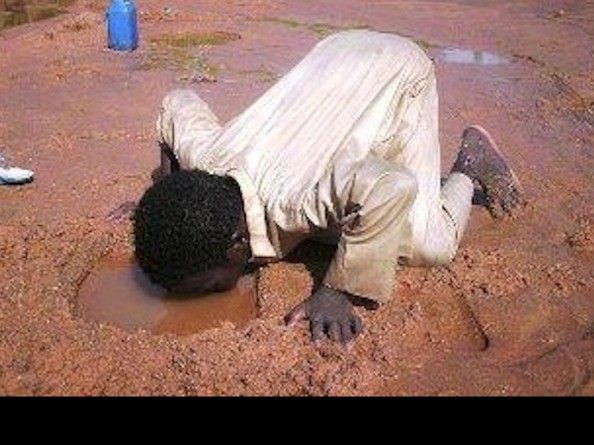
Why should children drink this way?
Sanaba is a new aid agency based in Houston Texas, USA. They have put together a fundraising page to help provide clean water in rural areas of the Red Sea State in Sudan. They hope to raise $15,000.
In an effort to encourage hygienic practices and to reduce the incidence of water-related illnesses, SANABA plans to acquire and install portable water filtration systems in rural areas of Sudan. From these wells, clean drinking water will be made available to students attending the community center, as well as to members of the public at large.
Our initial plan is to create a means of distribution of clean water in specific locations for the people in the community near our educational center. The first major consideration is a strategic plan to lay the ground work for wells to be identified, maintained and secured. The plan extends to educating the people in the community about the project, and is vital to any program.
Read about the fundraising program.
June 18, 2012
Kassala students protest higher prices

Police walk on the street as the rally is broken up in Khartoum.
Students in Kassala demonstrated on the streets yesterday, and the police were called out to suppress the public display of frustration over the federal government's planned austerity measures.
Protests also took place in Khartoum and Shendi. The students called for the downfall of the government. In Khartoum, about 200 students participated.
The protests come ahead of plans by the government to end fuel subsidies as part of what officials describe as drastic austerity measures need to fill a budget gap of 2.4 billion USD.
Sudan's economy has been grappling with soaring inflation and a depreciating currency since the country lost three quarters of its oil production with the secession of South Sudan in July last year.
Inflation jumped to 30 percent in May, mainly on food prices, as the Sudanese pound continues to reach new lows in the black market for hard currency.
Allafrica source.
Photo via [Sudan Revolution-facebook]
June 16, 2012
Aid improves Kassala water supply

The June 2012 edition of JICA's World points out
that 1.1 billion people do not have access to safe drinking water.
that 1.1 billion people do not have access to safe drinking water.
The Japanese International Cooperation Agency has been active in east and central Sudan, and South Sudan for some years. It is not clear if their work has recently been suspended by government order.
In Kassala, the JICA has been working on three projects:
a Capacity Development Project for the Provision of Services for Basic Human Needs in Kassala/ 2011.5-2014.5
The Project for Urgent Improvement of Water Supply Facilities at Kassala City/ 2011.4In 2010, Japan granted aid worth $92 million US to Sudan, and provided almost $26 million US in technical cooperation.
The Project for Improvement of Water Supply System at Kassala City (Detailed Design)/ 2011.8
June 14, 2012
Historic description of Bisharin tribes

From The Anglo-Egyptian Sudan: a compendium prepared by the officers of the Sudan Government. Edited by Count Gleichen Volume 1, 1905
Text was originally scanned- some spelling mistakes may exist...
The Bisharin
The Bisharin inhabit the desert bounded on the north, roughly, by the Alagi and its tributaries, on the south by the Atbara, on the east by the Red Sea from Shalatein to J. Asotriba, and thence by a Hne joining Mitateb or Umbeiba on the Atbara, and on the west by the Nile from the mouth of the Atbara to Abu Hamed, and thence by the old trade route from Abu Hamed to Korosko.
The Ababda and Bisharin formerly lived a good deal further south in the districts now occupied by the Hadendoas; both tribes moved northwards probably about 100 years ago.
The Ababda by their move north, came into a more civilised country. Their Sheikhs, through the transport needed on the Korosko—Abu Hamed road, came into touch with the Government and acquired at this time great wealth, and with wealth, their numbers increased, whilst the Bisharin of the hills, left far behind as regards progressiveness, soon came to be despised by them.
The Bisharin claim descent from Bishar, the son of Kahl, who was also the father of Abad and Amar, from whom the Ababda and Amarar are said to have sprung.
Kahl is said to have been descended from Zubeir Ibn El Awam,* whose wife was a sister of Abbas, uncle of the Prophet. They maintain, therefore, that they are descended from the noble Koreish Tribe. In the genealogy of the tribe, the three principal ancestors are Kahl, Bishar, and Ali Jalan; on this all accounts seem to agree. The present generation of Sheikhs is generally said to be the ninth or tenth from Ali Jalan.
The descendants of Kahl most likely originally inhabited part of the district now occupied by the Hadendoas, the Bisharin, and Ababda, as stated above, having latterly moved northwards.
The Bisharin are divided into two great families, the Um Ali and Um Naji. The former live in the north, the latter in the south, of their country. Both sections are named after the wives of Ali Jalan, the great grandson of Bishar, who had the following sons :—
Ali .. Shanatir Amer . Hamedor Aliab. Shantirab. Amrab. Hamedorab. Hanr . Eira . Nafi . Mansur
Hanr. Eireiab. Nafab. Mansurab.
Boundaries of Bisharin.
Aliab.— The Aliab, who are far more numerous and wealthy than any of the Um Ali or Um Naji tribes, are divided into the following sub-tribes : Koatil, Mallak, Hamedomerab, Kurbeilab, and Balgab.
The first three named are sometimes classed together and known as the Sararab, on account of their near common ancestry.
The Sheikh of the Koatil has for two generations been the representative Sheikh of these three families ; before this the Sheikhship was with the Hamedomerab.
Sub-tribes of the Aliab.
Koatil.— The Koatil, under Sheikh Isa Abdalla, are a small tribe, and poor. They live at Meshushenai and Terfaui.
Hamedomerab. —Sheikh Mohammed Wad Kurab. This, again, is a small tribe, owning few camels, but good flocks of sheep and goats. Wadi Meisa, at the head of which is Bir Meisa, is where most of the tribe are to be found during the summer. Their two wells are Meisa and Didaut, close together in the small hills north of the Elba red granite range.
Mallak.— Sheikh Isa Shingeirab. The Mallak, the third Sararab tribe, is by far the richest, and own many camels, and of a breed which is famous among all the neighbouring tribes. The Mallak own many wells.
Balgab.— The next of the Aliab tribes is the Balgab (Isa Abdalla), who live in the hills about Is. They have never, since the time of Abdalla, the father of Isa, had a representative Sheikh, but have always been represented by the Sheikh of the Sararab. They have good herds of camels, sheep, and goats. They do not frequent the Aswan market as much as the other Aliab sub-tribes, but they sell a great deal to merchants who come from there, and buy much of their corn in good
* In spite of their claim to be of Semitic origin, the Bisharin are not true Arabs and are of Hamitic descent,...
Compensation for murder or wounds.
The traditional "diia" or compensation for loss of life among these Arabs is: for a man, 50 male and 50 female camels; for women or children, or loss of legs, arms, eyes, 25 male and 25 female camels.
Wounds are assessed according to their gravity. The cause in which murders are committed, or a wound is received, is always taken into consideration. The above amounts are the limit of compensation.
Get your own copy of this 412 page book.
This book is available for about $20.00 CAN from the University of Toronto print on demand book publishing program. Search here to order... Or get it for about $10 from the University of Pittsburgh.
June 11, 2012
INTERNET: Beja facebook groups
An incomplete selection...

https://www.facebook.com/groups/280932275271355/

Beja Massacre Protest - 29th Jan
Beja Tribes of East Sudan
Beja culture group
مركز دراسات ثقافة البجـــا
Beja Cultural Studies Centre, at Red Sea University in Port Sudan
https://www.facebook.com/pages/مركز-دراسات-ثقافة-البجـــا/197498656950390

https://www.facebook.com/groups/eastsudancomf/


Beja Tribes of East Sudan
https://www.facebook.com/groups/41608082113/
MORE!
Are you interested in some websites?
June 8, 2012
More electricity projects in eastern Sudan

Kuwaiti Extends $200m Loan for Electricity Projects in Eastern Sudan
Khartoum - The Executive Director of the Fund for Rehabilitation and
Development in Eastern Sudan, Engineer Abu-Obieda Mohamed Duj, has
announced completion of studies and designs on electricity projects in
eastern Sudan, praising the State of Kuwait for its commitment during
the Donors Conference for Eastern Sudan Development.
Engineer Duj affirmed during a meeting at his office Monday with the
visiting mission of Kuwaiti Fund for Arab Economic Development that the
work in the project would begin before the end of the current year,
asserting the full coordination between the fund and the parties
concerned with implementation, supervision, operation and maintenance.
He touched on the positive impact of the project and the development
progress that would be realized following establishment of the lines
carrying electricity and connecting them with the lines coming from
Sinja, Siteit and Meroe Dams, in the fields of housing, agricultural and
industrial sectors in the three states of eastern Sudan.
Meanwhile, member of the mission and the Legal Advisor of the Fund,
Nawaf Abdallah Al-Mahal, announced completion of the administrative
procedures for the initial signing of the loan agreement for financing
of electricity project for the eastern Sudan scheduled for next week at
57 million Kuwaiti dinnars (about 200 million dollars), praising the
high professionalism of the staff of the Fund for Rehabilitation and
Development of Eastern Sudan in preparation for feasibility studies and
engineering designs.
__________________Sourced from prolific blogger Lady Gaga at Skyscraper City.
In other news,
Kennan Sugar Company and ERIDANIA one of the biggest Italian sugar companies will sign soon an agreement to erect a Sugar Refinery in Port Sudan for export, an investment that is estimated to reach about $130 million and considered one of the biggest European investments in Sudan...
June 7, 2012
Analysis: Aid NGO expulsion

Further discussion has been posted at Enoughproject.org [Khartoum’s Pattern of Neglect Continues in Eastern Sudan as Government Expels Aid Groups June 5, 2012]
Selections:
The decision last week by the Sudanese Humanitarian Affairs Commission, or HAC, to suspend projects in the deeply impoverished East is yet another example of Khartoum’s continued pattern of obstruction and neglect of peripheral areas.
Though rarely in the international news headlines, the East has been plagued by similar patterns of discrimination and disenfranchisement as the other peripheral areas of Sudan. The East has shockingly poor humanitarian indicators, largely the result of Khartoum’s sustained neglect.
Until a comprehensive strategy to promote inclusive constitutional reform and democratic transformation for all communities within Sudan is adopted Khartoum will continue to use humanitarian aid, and the lives of those dependent on it, as a political tool.
Read the complete article, it's not too long.
June 6, 2012
June 5, 2012
New regional map available

New cover! 2012.
Here's a supplier in the United Kingdom. And another one. Make sure to ask for the latest edition.
In the USA try maps.com
Maptown, in Alberta, Canada...
This is what the old cover looks like. Don't get this one, the map date from 2003...

old cover from 2003

old inside
June 3, 2012
Beja Congress deplores explusion of aid agencies

The Beja Congress has responded to the federal government of Sudan. Seven NGOs have been told to stop work in east Sudan for 30 days, as reported yesterday on the blog.
Here is the Press Release from the Beja Congress as found on sudan eyes. Originally available at Sudanese online .
= = = = = = =
The so called Humanitarian Aid Office (HAO) in Khartoum announced the expulsion of seven humanitarian aid organizations from eastern Sudan, claiming their violation of the obligations of voluntary work. These includes Save the Children of Sweden, the Irish GOAL, Accord and NATs Roche and the Japanese Plan Sudan.
The HAO has threatened that the government would not tolerate any slip of the organizations to the security laws.
This is not the first time that the authority expels humanitarian organizations from rural areas of the East, it has already expelled all aid organizations in its early years of its seizure of power in 1989, and during and after the war of liberation.
But under strong pressure from the international community, the government allowed the return of these organization. It is known that these aid organizations work to provide primary health care and the provision of food aid in the far remote rural areas, where there is no trace of any governmental care.
These organizations submit their reports regularly to the authorities, as agreed upon.
But the reports indicate that the humanitarian suffering continues to increase. Diseases like TB, anaemia, malnutrition and diarrhea are rising, which results in the increase of mortality, especially among children and women.
The decision to expel humanitarian aid organizations from the states of the East, is highly irresponsible, and would result in the increase in humanitarian sufferings in the remote areas of eastern Sudan, which are particularly impoverished, poor and underdeveloped.
The government is not even putting in consideration to access these regions for inspection, not speak of development. They are beyond its scope of horizon.
The expulsion of the aid organizations that only operate in eastern Sudan, where they are dearly needed, amounts to genocide through starvation.
Beja Congress deplores and strongly condemns their expulsion and calls upon all the activists in the health services, clergy, community leaders, students and all youth organizations and members of political organizations to enforce the return of these humanitarian organizations.
Beja Congress appeals appeals to the international community and especially to the United Nations, the European Parliament, the Organization of African Unity and all democratic organizations to exercise the necessary pressure on the government of Sudan to allow the return back of these organizations.
http://www.bbc.co.uk/news/world-africa-18296430
Dr Abu Amna
Beja Congress leadership
Alternate source of press release on Sunday, June 3, 2012, at https://www.facebook.com/BejaCongressUK

The BBC article linked above reads, in part:
At least four aid
organisations have been banned from working in the deeply impoverished
eastern region of Sudan, sources have told the BBC.
An official at the Humanitarian Affairs Commission (HAC), who asked not to be named, told AFP the non-governmental organisations being told to stop working in the east were Save the Children Sweden, GOAL of Ireland, a Japanese humanitarian group and another Irish organisation.
"The HAC decided to expel four international NGOs working in eastern Sudan because they failed in their planned projects," the HAC source told AFP.
The head of one of the organisations concerned told the BBC he was intending to appeal against the decision.
An unnamed Sudanese official told the AFP news agency the aid groups had "failed in their planned projects".
A BBC reporter says Sudan has in the past restricted the work of foreign humanitarian agencies, accusing them of working to destabilise the country.
Fears of fresh rebellion
The BBC's James Copnall in Khartoum says eastern Sudan is a particularly sensitive subject for the Sudanese government at the moment because there are fears that a rebellion could break out again. The area is made up of Red Sea, Gedaraf and Kassala states. But the region is particularly poor and underdeveloped region.
In 2010, donors and investors pledged more than $3.5bn (£2.2bn) to eastern Sudan at a conference in Kuwait - but frustration is growing because many of its people say they have not seen the benefits of that pledge or the peace deal, our correspondent says.
The activities of the aid groups elsewhere in Sudan have reportedly not been restricted.
In 2009 President Omar al-Bashir was indicted by the International Criminal Court for crimes allegedly committed in Darfur, in the west of the country.
The next day 13 aid organisations were expelled from the country. Senior Sudanese officials often accuse aid workers of collaborating with the ICC, and unnamed "foreign powers", our correspondent says.
Subscribe to:
Posts (Atom)
